






The Lower Berth: Convenience vs. Chaos
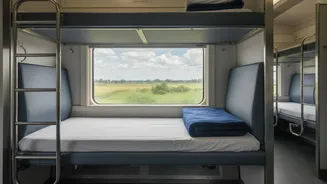
The lower berth is the undisputed champion of convenience. Often preferred by senior citizens and families with children, it requires no climbing and offers easy access to the aisle and washrooms. During the day, it serves as the communal seating area
for all three passengers in the bay, making it a social hub. You get a window seat and prime access to the small fold-out table. However, this convenience comes at a significant cost to your sleep. As the default seating area, you are the last to go to bed, waiting for your co-passengers to retire. Your sleep is also most likely to be disturbed by people getting on or off at stations, the bright lights from platforms, and general movement within the coach. It's a trade-off: what you gain in mobility, you lose in peace and privacy.
The Middle Berth: A Delicate Compromise
The middle berth is perhaps the most dependent on the cooperation of others. You can neither go to sleep early nor wake up late, as your berth's existence is tied to the lower berth passenger's schedule. Typically, passengers agree to fold it down around 10 p.m. and it must be folded back up in the morning so others can sit. This makes it unsuitable for anyone wanting to sleep during the day. While it offers some buffer from the aisle traffic that plagues the lower berth, you are sandwiched between two other people, which some find claustrophobic. It provides a better night's sleep than the lower berth by being elevated from most of the floor-level commotion, but it offers almost no flexibility, making it the least preferred option for many seasoned travellers.
The Upper Berth: Your Private Cocoon
For those whose top priority is uninterrupted sleep, the upper berth is the clear winner. Once you're up there, you are in your own world. You can go to sleep whenever you please and wake up at your leisure without anyone disturbing you to make space. It offers the most privacy and a greater sense of security for both yourself and your luggage, which can be tucked away beside you. The main drawbacks are the climb, which can be difficult for some, and the lack of a window view. In AC coaches, it can also get quite cold as it's closest to the air conditioning vents. However, for pure, undisturbed rest, free from the social obligations and constant traffic of the lower levels, the upper berth is unmatched.
Side Berths: A Different Calculation
The side berths operate on a different logic. The side lower berth offers the best of both worlds during the day: a dedicated two-person seating area with a large window. But at night, it shares many of the lower berth's problems, including interruptions and a lack of privacy due to its position along the main aisle. The side upper berth, meanwhile, combines the privacy of a regular upper berth with a slightly more exposed position. A key point to note is that side berths are slightly shorter than the main berths, which can be a problem for taller individuals. For solo travellers who value their sleep, the side upper is often considered a top choice, providing a private space to rest away from the main bay of six.