

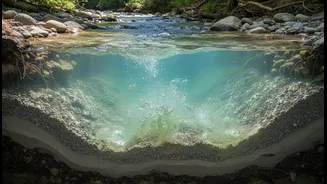


The Wisdom of Indigenous Engineering
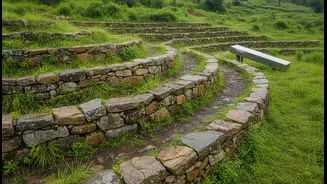
At the heart of this movement is a method analogous to traditional Khasi stone bunding. For centuries, communities in the Khasi and Jaintia hills have used their deep understanding of the local landscape to build simple yet highly effective structures
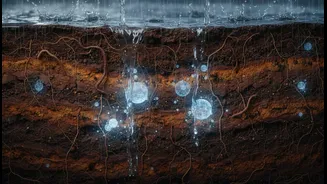
for managing water and preventing soil erosion. These are not solid walls, but permeable barriers constructed from locally sourced stones, often without any mortar. Placed along the contours of a slope, these bunds slow down the flow of rainwater instead of blocking it entirely. This simple action has profound effects: it allows more water to percolate into the ground, replenishing the water table, and it causes sediment to be deposited behind the bund, gradually forming natural terraces. This ancient technique is a masterclass in working with nature, not against it.
The Conventional Steel Approach
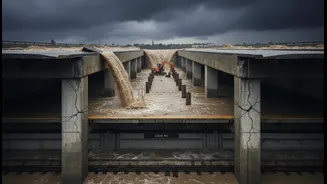
The modern alternative for controlling erosion and water flow often involves steel deflectors or similar structures like sheet piles and gabions. These are engineered, impermeable barriers designed to redirect or completely block water flow. While strong and durable, they represent a fundamentally different philosophy. Their construction is energy-intensive, relying on the production and transportation of steel, a process with a significant carbon footprint. Steel structures are fabricated to precise specifications, often off-site, and then installed with heavy machinery. While effective in their own right for specific engineering challenges, they impose a rigid solution onto a dynamic natural environment.
A Question of Sustainability
For eco-conscious builders, the environmental calculus is clear. Khasi-inspired stone bunding uses materials found on-site, eliminating the emissions and costs associated with manufacturing and long-distance transport. The technique promotes biodiversity; the permeable structure can become a micro-habitat for local flora and fauna. By increasing water infiltration, it combats the drying of springs and streams, a growing problem even in high-rainfall areas like Meghalaya. Steel, while recyclable, has a high initial environmental cost. The production process contributes to greenhouse gas emissions, and the mining of iron ore can lead to habitat destruction and soil erosion—the very problem it's meant to solve. Furthermore, impermeable steel walls can disrupt natural water courses and aquatic ecosystems, effectively 'killing' a river downstream by altering its natural flow and sediment transport.
Cost, Community, and Resilience
The economic argument is just as compelling. Stone bunding is significantly cheaper, primarily involving manual labour which can be sourced locally, boosting the community economy. Studies on indigenous soil and water conservation methods show they have a positive net present value and contribute to long-term economic and environmental sustainability. Steel deflectors, in contrast, are expensive not only in terms of materials but also installation and maintenance. The traditional methods, honed over generations, are inherently resilient and adapted to the local climate. They are flexible and can be maintained and repaired by the community using the same readily available materials. This community involvement fosters a sense of ownership and preserves invaluable traditional knowledge that has been passed down through generations.
A Lesson for Modern India
The preference for Khasi stone bund analogues is more than just a choice between two building techniques; it's a recognition that sustainable development requires a blend of modern science and ancestral wisdom. These indigenous methods are not relics of the past but are sophisticated, place-based solutions that are often more effective, cheaper, and far more ecologically sound than their industrial counterparts. In a country grappling with the twin challenges of climate change and rapid urbanisation, the simple stone bunds of Meghalaya offer a powerful lesson in resilience, sustainability, and respecting the delicate balance of the natural world. They prove that sometimes, the most advanced solution is the one that has been under our feet all along.