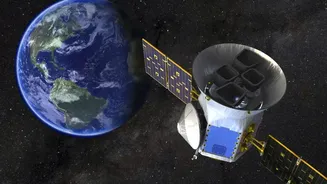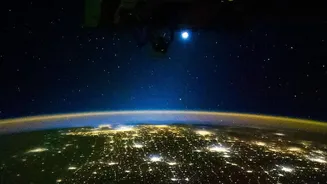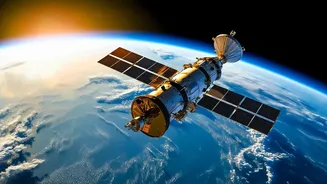







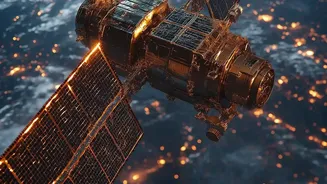
The insatiable global demand for data and AI is pushing infrastructure to its limits, causing some companies to look to the final frontier. But placing massive data centres in orbit could come at a steep cost to science.
The Final Frontier for Data
The concept sounds like science
fiction: vast, solar-powered data centres orbiting Earth, processing immense quantities of information in the cold vacuum of space. Yet, this is rapidly becoming a serious business proposition. Facing constraints like land use, massive electricity demands, and the enormous water consumption needed for cooling, companies are exploring space as a solution. The key attractions are abundant, uninterrupted solar power and a naturally frigid environment. In a sun-synchronous orbit, a satellite can be in near-constant sunlight, generating far more energy than a comparable solar farm on the ground. This could, in theory, help satisfy the booming energy needs of artificial intelligence. Several startups, including Starcloud, Axiom Space, and Aethero, along with major players like SpaceX, are actively developing or proposing orbital computing projects, from small-scale edge computing for satellites to large-scale AI processing for users on Earth.
A Shadow in the Sky for Astronomy
While the technical and business case is being built, the astronomical community is raising serious alarms. The problem is twofold and strikes at the heart of how we observe the universe from the ground. First is the issue of light pollution. To power these facilities, they would need enormous solar arrays, potentially kilometres in size. These large, reflective surfaces would catch the sun's rays and shine brightly in the hours after sunset and before sunrise — critical times for many astronomical observations, including the search for potentially hazardous asteroids. Some projections suggest these orbital data centres could appear many times brighter than Venus, the brightest natural object in the night sky after the Moon. This would create bright streaks across long-exposure images, overwhelming the faint light from distant galaxies and stars and potentially rendering years of investment in ground-based telescopes obsolete.
The Problem of a 'Noisy' Sky
Beyond visible light, there is a threat of 'radio noise'. Ground-based radio telescopes are designed to detect incredibly faint radio waves from cosmic sources like pulsars and black holes. Satellite constellations already pose a challenge, as their communication signals can be orders of magnitude stronger than these faint cosmic whispers. Even more concerning is unintentional radiation. Studies of existing satellites, like those in the Starlink constellation, have found they leak radiation from their onboard electronics at frequencies that are supposed to be protected for radio astronomy. With data centres being far more complex and powerful, the fear is that a sky filled with them would create a persistent hum of radio frequency interference (RFI), effectively blinding radio telescopes to large swathes of the universe.
A Crowded and Contested Future
The proliferation of any large satellite constellation adds to the growing problem of orbital debris and the risk of collisions. Manoeuvring kilometre - scale data centres to avoid impacts would be difficult. A collision could trigger a runaway debris cascade, making certain orbits unusable for generations. This emerging conflict highlights a larger issue : the commercialisation of low Earth orbit is outpacing regulation. There are currently no international rules governing the brightness of satellites or their unintentional radio emissions. Organisations like the International Astronomical Union (IAU) are working with satellite operators to establish guidelines and mitigation strategies, urging companies to design satellites to be as 'dark and quiet' as possible. These recommendations include operating at lower altitudes, using less reflective materials, and sharing precise location data to help observatories plan around them. However, these are largely voluntary measures, and the scale of proposed data centre constellations is far beyond anything currently in orbit.