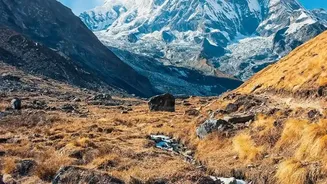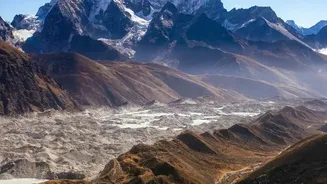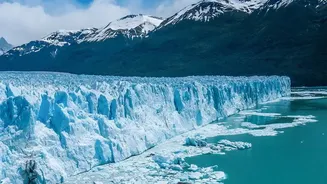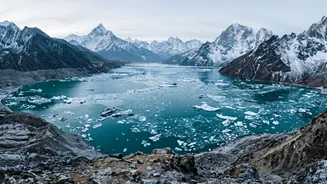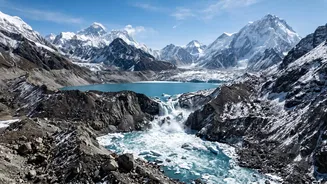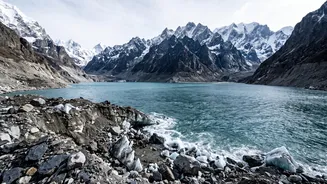





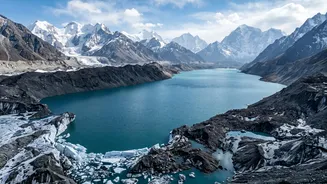
High in the Himalayas, thousands of new lakes are forming as glaciers melt at an alarming rate. While beautiful, many are 'ticking time bombs'. Recent UN reports warn that the risk of catastrophic outburst floods is growing, urging immediate action.
What is a Glacial Lake Outburst Flood?
A
Glacial Lake Outburst Flood, or GLOF, is a sudden and powerful flood that occurs when the natural dam containing a glacial lake fails. As climate change warms the planet, Himalayan glaciers are retreating, leaving behind vast pools of meltwater. These lakes are often held in place by unstable dams made of loose rock and soil, known as moraines. When the volume of water becomes too great, or when an external trigger like an avalanche or earthquake occurs, these fragile dams can burst. The result is a terrifying wall of water, mud, and debris, capable of surging down mountain valleys with immense speed and destructive force, wiping out everything in its path.
The Himalayan Threat Magnified
The Hindu Kush Himalaya region is warming significantly faster than the global average, accelerating glacier melt and the formation of these dangerous lakes. A UN-backed study in 2020 identified 47 potentially dangerous glacial lakes across river basins in India, Nepal, and China, but officials now warn the true number is significantly higher. A recent UNDP assessment suggests millions of people are now at risk. Compounding the danger, rapid and often unregulated construction of hydropower projects, roads, and settlements along river channels has placed more people and critical infrastructure directly in the path of potential GLOFs. A new UN-led study found that between 1835 and 2025, India recorded over 6,100 deaths from GLOFs, the highest toll among eight Himalayan nations.
A UN Wake-Up Call After Recent Disasters
The urgency of the situation has been underscored by recent catastrophic events. A devastating flood in Nepal in August 2026, which killed over 1,500 people, served as a grim reminder of the region's vulnerability. While that event was triggered by a glacier collapse rather than a lake outburst, UN officials say both threats are rising due to climate change. More recently, a GLOF in Bhutan in late October 2026 prompted Indian authorities to issue alerts for downstream areas in West Bengal and Assam. These events have prompted senior UN officials to describe the situation as a 'defining moment', warning that entire riverbanks where millions live could become uninhabitable without swift action.
A Threat That Knows No Borders
A critical challenge highlighted by the UN is that GLOFs do not respect international borders. A dangerous lake may be situated in China or Nepal, but its outburst could unleash a devastating flood that travels hundreds of kilometres downstream into India. For instance, of the 47 high-risk lakes identified in one study relevant to Nepal, 25 were in China and one was on the Indian border. This cross-border reality makes isolated, national-level efforts insufficient. Following recent disasters, officials from Nepal have called for a 'Himalayan Climate Resilience Mechanism' involving Nepal, India, and China to share satellite data, monitor lakes jointly, and coordinate early warning systems across borders.
From Warning to Action in India
India is moving from a reactive to a proactive stance on GLOF risk. Prompted by tragedies like the 2023 Sikkim flood, the National Disaster Management Authority (NDMA) has launched a National GLOF Risk Mitigation Programme. This initiative has identified 190 high-risk glacial lakes across Himachal Pradesh, Sikkim, Ladakh, Arunachal Pradesh, Jammu & Kashmir, and Uttarakhand for priority action. The programme focuses on hazard mapping, installing automated monitoring and early warning systems, and building community awareness. The goal is to create a robust system that can provide precious warning time for downstream communities to evacuate, but experts stress the need to accelerate and scale up these efforts urgently.