





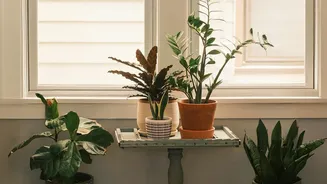
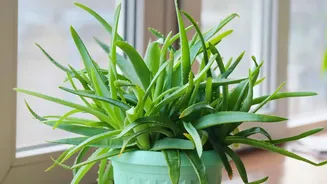
Have you noticed your favorite houseplant starting to lean, looking more like a lopsided sculpture than a lush, upright specimen? This common behaviour is a natural response to light, and the simple act of rotating the pot is key to fixing it.
The Science of the Lean
The tendency
for plants to grow towards a light source is a biological process called phototropism. It's a survival instinct designed to help plants maximize their exposure to sunlight for photosynthesis, the process they use to create energy. This bending is controlled by a plant hormone called auxin. Auxin promotes cell elongation and accumulates on the shadier side of the stem. As the cells on the dark side grow longer and faster than those on the sunny side, the stem naturally curves towards the light, creating that familiar lean.
More Than Just Good Looks
While a symmetrical plant is certainly more aesthetically pleasing, the benefits of rotation go beyond appearances. Regularly turning your plant ensures all its leaves get a fair share of light, promoting fuller, more balanced foliage and preventing one side from becoming sparse or 'leggy'. This even light distribution allows the entire plant to photosynthesize more effectively, leading to more robust overall health and stronger stems. Furthermore, rotating your plant improves air circulation around the foliage, which can help reduce the risk of pests and fungal diseases that thrive in stagnant conditions.
The Art of the Turn
So, how often should you be turning your plants? There isn't a single strict rule, as it depends on factors like the plant species and the intensity of the light source. However, a widely recommended and easy-to-remember guideline is to give your plant a quarter-turn each time you water it. This ensures a slow, consistent rotation that prevents the plant from getting too settled in one direction. For plants in lower light conditions, you might rotate them every few weeks, while those in very bright spots may only need it every few months. The key is consistency. Picking a direction and sticking to it will help you create a simple, effective routine.
When Not to Rotate
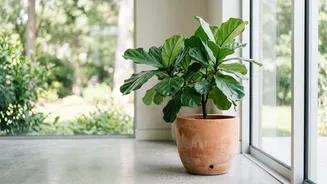
While most houseplants benefit from regular turning, there are exceptions. Forcing symmetry on every plant isn't always necessary or natural. Some vining or climbing plants, like many philodendrons and pothos, have a distinct front and back side and can be stressed by constant reorientation. It's also wise to avoid rotating flowering plants like orchids or Christmas cacti once they have set their buds. Changing their orientation to the light at this critical stage can cause them to drop their buds before they bloom. For many plants, especially large ones like the Fiddle Leaf Fig or Monstera, embracing their natural lean towards the light can be part of their character, creating a more sculptural and intentional look in a room.
Beyond the Windowsill
The principle of rotation also applies to plants grown under artificial lights. If you are using a single grow light positioned to one side, it creates the same effect as a window, and your plant will lean towards it. In this case, rotating the plant is just as important. However, if you have a grow light positioned directly above the plant that provides even, overhead coverage, rotation is generally not necessary because the light is already distributed symmetrically.