







Beyond Looking Up
For generations, learning about astronomy meant memorising distances and diameters, staring at grainy photos, and trying to imagine the unimaginable scale of the cosmos. The numbers are staggering, the physics complex, and the objects themselves are light-years
away. This abstraction can create a disconnect, making a fascinating subject feel remote and inaccessible. But a hands-on approach is changing that relationship. The simple act of construction—whether it's assembling a multi-billion dollar observatory or a simple classroom model—transforms abstract concepts into tangible experiences. It turns passive observers into active participants in the quest to understand the universe. This shift from purely theoretical to experiential learning is making astronomy more intuitive, engaging, and meaningful for everyone from professional scientists to primary school students.
Building the Universe’s Biggest Eyes
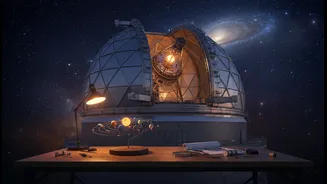
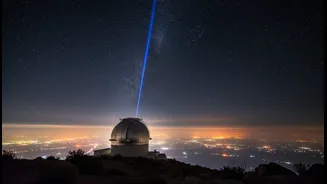
On the grandest scale, India is deeply involved in constructing the next generation of mega-telescopes, turning abstract scientific goals into concrete engineering challenges. Take the Thirty Meter Telescope (TMT) and the Square Kilometre Array (SKA), two of the most ambitious science projects in history. India is a key partner in both. For the TMT, India is responsible for developing crucial components like the mirror control system, segment supports, and polishing over 100 mirror segments. This isn't just a financial contribution; it's a deep, in-kind involvement where Indian industry and research institutes are building the hardware that will allow us to see the early universe. Similarly, for the SKA, India has led the design of the Telescope Manager—the complex software 'brain' of the entire observatory. This involvement makes the science real. The quest for distant galaxies becomes a problem of precision engineering and advanced software development, grounding cosmic ambitions in earthly enterprise.
From the Stars to the Classroom
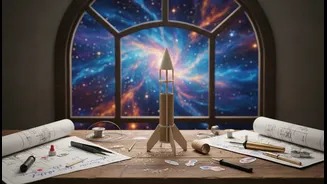
This principle of 'learning by doing' is having a profound impact on education. In India, numerous initiatives are bringing cosmic construction into schools. Programs like SPACE India's 'Universe in The School' and Edugenius's 'Space & Astronomy Lab' focus on experiential learning, where students build their own model rockets, assemble working telescopes, and create models of rovers like Pragyan. When a student builds a scale model of the solar system, the abstract concept of astronomical distance suddenly clicks into place. Assembling a telescope makes optics and light tangible. These hands-on activities don't just teach facts; they build scientific temperament and critical thinking. This aligns with India's National Education Policy 2020, which emphasizes inquiry-based learning, and recent partnerships, like the one between NCERT and the Space Education Foundation, aim to integrate this approach nationwide.
The DIY Astronomer
The democratization of astronomy extends beyond the classroom to a vibrant community of citizen scientists. Projects like RAD@home, India's first citizen-science research platform in astronomy, empower undergraduates and enthusiasts to analyse real astronomical data, often from facilities like the Giant Metrewave Radio Telescope (GMRT). This is a form of virtual construction—building knowledge by piecing together data. In 2025, a volunteer attending a RAD@home online class discovered a rare 'bow-and-arrow' shaped radio galaxy that automated systems had missed, highlighting the irreplaceable value of the trained human eye. By participating in this process of discovery, citizens are no longer just consumers of scientific knowledge; they are active contributors. This active role fosters a deep, personal connection to the cosmos, turning abstract celestial phenomena into a personal puzzle to be solved.