


The Sound of Spacetime Rippling
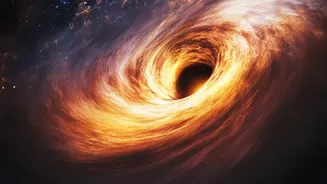
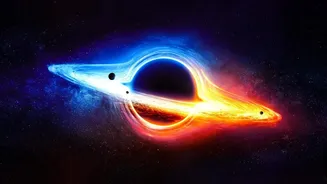
Imagine dropping two bowling balls into a still pond. The ripples they create spread outward, carrying information about the event. Now, imagine those bowling balls are black holes, and the pond is the very fabric of spacetime. When two black holes spiral
into each other and merge, they create a violent disturbance that sends ripples, known as gravitational waves, across the universe at the speed of light. Predicted by Albert Einstein a century ago, these waves are incredibly faint by the time they reach us. Detecting them requires instruments of almost unimaginable sensitivity, capable of measuring a distortion in spacetime thousands of times smaller than a proton. The first successful detection in 2015 by the Laser Interferometer Gravitational-Wave Observatory (LIGO) didn't just prove Einstein right; it gave humanity a completely new sense with which to perceive the cosmos.
A New Cosmic Measuring Tape
One of the biggest puzzles in cosmology today is the 'Hubble tension'. This is a persistent disagreement between two different methods of measuring how fast the universe is expanding. Measurements of the early universe suggest one number for the expansion rate (the Hubble constant), while measurements of the local, modern universe suggest another, slightly faster one. This discrepancy could point to new physics or flaws in our understanding of the cosmos. Gravitational waves offer a completely independent way to measure this expansion. By analyzing the signal from a black hole merger, scientists can directly calculate how far away the event occurred. If a telescope can also spot an electromagnetic counterpart to the event—like a flash of light from a merger involving a neutron star or one happening in the disc of an active galactic nucleus—astronomers can identify the host galaxy and measure its speed. Distance plus speed gives a new, clean measurement of the Hubble constant, a method often called the 'standard siren' approach.
Mapping the Universe's Hidden Structures
Black hole collisions don't just happen anywhere. They are thought to occur more frequently in dense environments, like the hearts of galaxies or crowded stellar clusters. The ever-growing catalog of gravitational wave events, which now numbers in the hundreds, acts like a cosmic census. By mapping where and how often these mergers occur, scientists can start to trace the unseen scaffolding of the universe. The latest observing runs by the LIGO-Virgo-KAGRA (LVK) collaboration have added huge numbers of new detections, allowing for population-level studies. These studies help astronomers understand how galaxies form and grow, and how matter, both visible and dark, is distributed throughout the cosmos. Each detection is a pin on a vast, dark map, slowly revealing the grand structure of everything.
Rewriting the Lives of Black Holes
The details encoded within a gravitational wave signal tell a rich story about the objects that created it, including their mass and spin. Some recently detected collisions have involved black holes with peculiar characteristics, suggesting they weren't formed from a single star's collapse. Instead, their properties indicate they might be 'second-generation' black holes, meaning they were themselves formed from a previous merger. This process, called hierarchical merging, was once just a theory. Observing it helps explain the existence of unexpectedly massive black holes and confirms that some cosmic regions are dynamic demolition derbies where black holes collide repeatedly. These observations provide a direct window into the life cycle of the universe's most extreme objects and the growth of structure over cosmic time.