







Seeing in a New Light
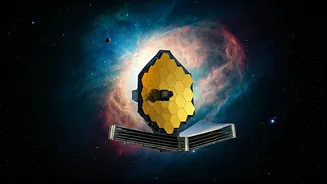
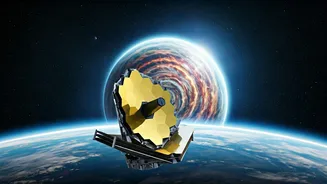
The secret to Webb's power is its ability to see in infrared, which we perceive as heat. Planets, even those light-years away, give off their own thermal glow. While this glow is incredibly faint compared to their host star, Webb's sensitive instruments
can pick it up. Scientists use a technique called thermal emission spectroscopy. They measure the total light from the star and planet system, and then measure it again when the planet passes behind the star. The difference between these two measurements is the light—or heat—coming directly from the planet itself. This allows astronomers to take the temperature of a world from quadrillions of kilometres away. It is the first time any telescope has had the sensitivity to measure such dim mid-infrared light from planets as small as those in our own solar system.
From Glow to Atmosphere
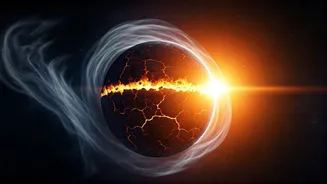
A planet's temperature provides the first major clue about its nature. For example, astronomers studied the rocky planet TRAPPIST-1 b, which is tidally locked, meaning one side always faces its star. They reasoned that if it had a thick atmosphere, winds would circulate heat, making the permanent "day" side cooler. Webb's measurement showed the dayside is a blistering 230 degrees Celsius, suggesting the planet is likely a bare rock with no significant atmosphere to redistribute the heat. This technique of measuring thermal emission is the only way to know if a planet has an atmosphere or not. The absence of an atmosphere is just as important a clue as the presence of one, helping scientists refine theories about which planets can hold onto their precious gases.
Mapping Weather on Alien Worlds
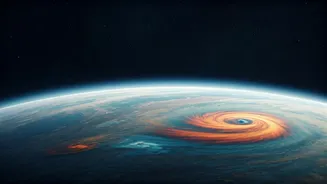
For planets that do have atmospheres, Webb can go even further. By observing a planet through its entire orbit, a technique known as creating a "phase curve," scientists can build a weather map. As the planet rotates, different parts of its surface come into view, allowing Webb to map temperature variations between the day and night sides. On the gas giant HD 80606 b, which has a wildly eccentric orbit, Webb recently watched the planet’s temperature spike by 600 degrees Celsius as it swung close to its star. These observations revealed not just the extreme heating, but also the chemical fingerprints of molecules like methane and carbon dioxide in the atmosphere, showing how the planet's chemistry responds to the intense burst of energy. This turns exoplanets into natural laboratories for studying extreme weather.
Unlocking Geological Secrets
The heat clues extend even to the ground beneath a planet's sky. For very hot, rocky planets, the type of rock on the surface can be identified by its unique infrared signature. Different minerals and rock types, like basalt or granite, glow differently at the same temperature. For the first time, with planets like LHS 3844 b, astronomers are analyzing light coming directly from the surface of a distant rocky world. While early results on these hot super-Earths often point to dark, barren rock, this is a monumental first step. It marks the beginning of exoplanet geology, where scientists can start to decipher the surface composition and history of worlds far beyond our own, moving beyond atmospheric studies to understand the very ground they are made of.