
Our Only Blueprint for Life
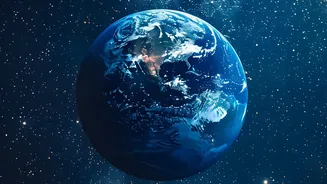
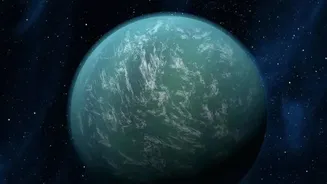
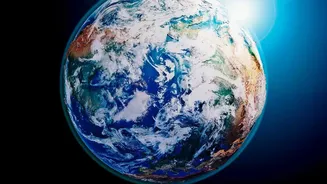
In the vast cosmos, with thousands of confirmed exoplanets, Earth remains our sole example of an inhabited world. This makes our planet the foundational blueprint in the search for extraterrestrial life. Scientists operate on a simple, powerful premise:
to find life elsewhere, we must first understand the conditions that allowed it to arise and flourish here. This involves defining what makes a planet 'habitable' in the first place. The most common starting point is the 'habitable zone'—often called the 'Goldilocks zone'—an orbital region around a star where conditions are just right for liquid water to exist on a planet's surface. Since all life as we know it requires liquid water, this concept provides a crucial first filter for astronomers deciding where to point their telescopes.
Reading Earth's Ancient History
Modern Earth, with its oxygen-rich atmosphere, is just one version of a habitable planet. Our world has undergone dramatic transformations over its 4.5-billion-year history. At different times, it has been a hazy, oxygen-free world choked with methane, a planet of global oceans, and perhaps even a 'snowball' covered in ice. By studying Earth's geological and atmospheric record, scientists gain access to multiple templates for what a living planet can look like at different stages of its evolution. This is vital, as a young, emerging biosphere on a distant exoplanet might look more like Earth's ancient past than its present day. Understanding these 'alternative Earths' allows researchers to widen their search parameters and consider planetary environments very different from our own.
The Chemical Fingerprints of Life
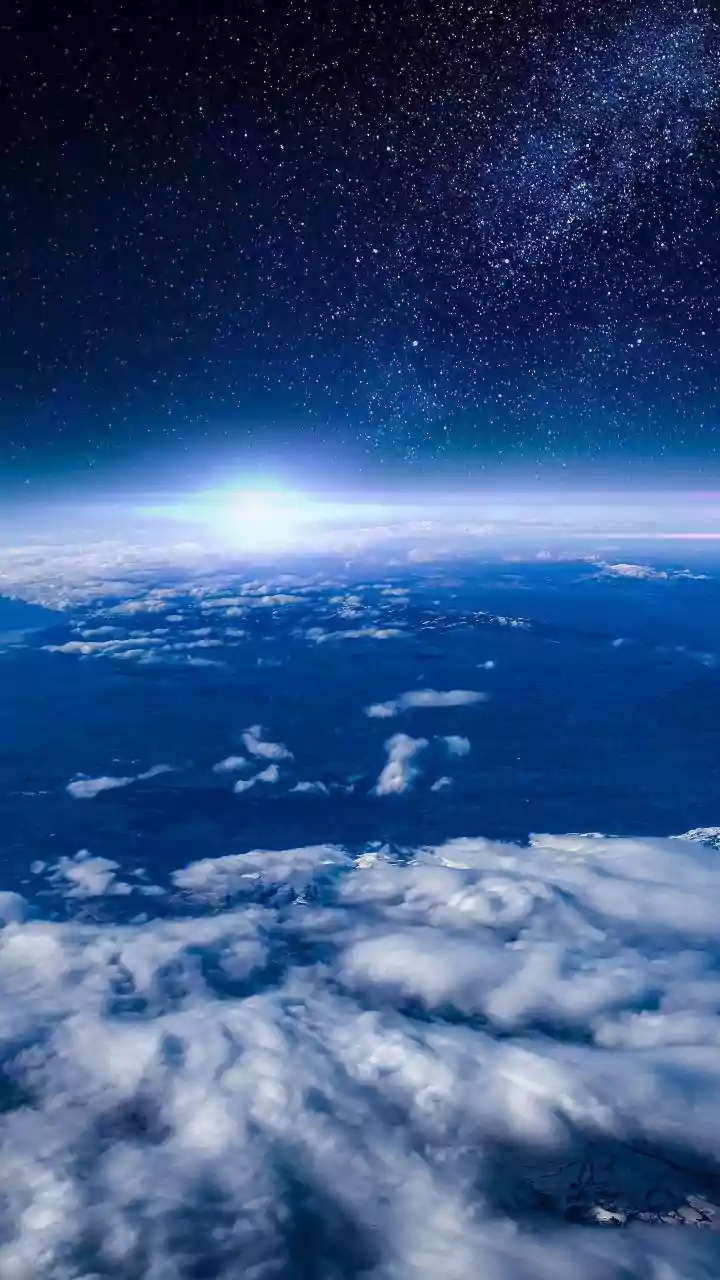
Life is not passive; it actively changes its environment. These changes can leave detectable clues called biosignatures. A biosignature is any substance, element, or pattern that provides evidence of past or present life. On Earth, life has fundamentally altered the composition of our atmosphere. The most famous biosignature is oxygen, which is overwhelmingly produced by photosynthesis. Without constant replenishment by plants and microbes, Earth's atmospheric oxygen would quickly react with minerals and disappear. Other gases, like methane, can also be signs of biological processes. The simultaneous presence of gases that shouldn't coexist, like oxygen and methane, is a particularly strong hint that a biological source is actively maintaining this chemical imbalance—a key biosignature that suggests a planet is inhabited.
From Template to Telescope
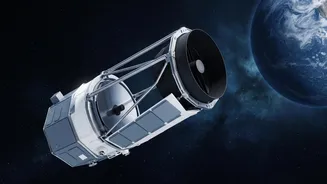
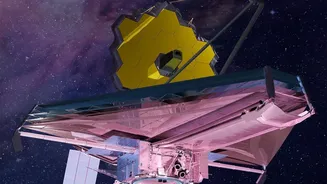
Armed with this Earth-centric knowledge, astronomers can use powerful observatories like the James Webb Space Telescope (JWST) to hunt for these signs. One primary method is transmission spectroscopy. When an exoplanet passes in front of its star, the starlight filters through the planet's atmosphere. By analysing this light, scientists can identify the chemical 'fingerprints' of different molecules, such as water vapor, methane, or oxygen. JWST is sensitive enough to detect these minute chemical traces in the atmospheres of rocky, Earth-sized worlds. In essence, scientists are comparing the atmospheric data from distant worlds to the various models of a living planet derived from Earth's own long history, searching for a familiar chemical echo across the interstellar void.
Beyond an Identical Twin
While Earth provides the primary template, scientists are careful not to develop a terrestrial bias. The search is not just for an identical twin of our planet, but for any world capable of supporting life. Studying extremophiles on Earth—organisms that thrive in scorching hydrothermal vents, acidic rivers, or frozen deserts—has shown that life is far more resilient and adaptable than once thought. This knowledge broadens the definition of a habitable environment. Furthermore, astrobiologists are also considering 'agnostic biosignatures,' which are signs of life not tied to any specific Earth-based biology, such as unexpected molecular complexity. By understanding the fundamental principles of life on Earth, from its chemistry to its resilience, we can better imagine the myriad forms it might take on other worlds.