


The Gentle Push of Sunlight
The secret to solar sailing lies in a phenomenon called solar radiation pressure. While sunlight warms your skin and powers solar panels, it also exerts a physical push. Light is made of particles called photons. Though they have no mass, photons carry
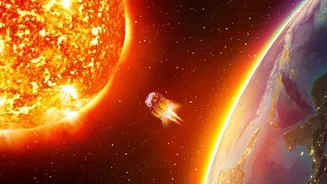
momentum. When billions upon billions of these particles strike a surface, they transfer their momentum, creating a tiny, continuous force. In the vacuum of space, where there is no friction to slow things down, this gentle but relentless pressure can accelerate a spacecraft to incredible speeds over time. It's less like the explosive power of a rocket and more like a constant, steady breeze at your back.
A Giant, Ultra-Thin Mirror
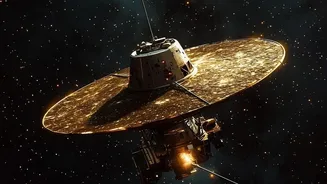
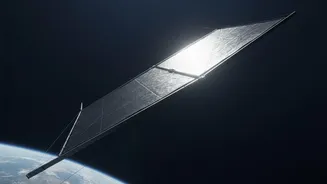
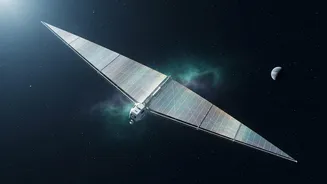
To catch this 'wind' of photons, you need a sail—a very big and very light one. A solar sail is essentially a giant, reflective sheet. These sails are crafted from advanced, ultra-thin materials like polyimide or Mylar, often coated with a layer of aluminum to make them highly reflective. The goal is to reflect as many photons as possible, because each bouncing photon imparts twice the momentum as one that gets absorbed. We're talking about materials thinner than a human hair, stretched out over enormous areas—sometimes spanning the size of a small apartment or even a basketball court. The entire structure, including its deployment booms, must be incredibly lightweight to maximize the acceleration from the sun's faint push.
Navigating the Cosmos
A solar sail doesn't just get pushed directly away from the sun. Much like a sailboat on water, a solar sail spacecraft can navigate. By changing the angle of the sail relative to the sun, mission controllers can adjust the direction of the thrust. Tilting the sail allows the spacecraft to either speed up and spiral away from the sun or slow down and move closer. This technique, known as 'tacking', enables complex maneuvers and precise orbital control without using a single drop of propellant. This capability opens up new possibilities for missions, allowing spacecraft to hover in unique orbits that would be impossible for conventional rockets.
From Theory to Proven Technology
What was once a theoretical concept is now a flight-proven technology. Japan's IKAROS (Interplanetary Kite-craft Accelerated by Radiation Of the Sun) mission, launched in 2010, was the world's first spacecraft to successfully demonstrate controlled solar sailing in interplanetary space on its journey towards Venus. Following that success, The Planetary Society's LightSail 2 mission, launched in 2019, proved that a small satellite could use a solar sail to raise its own orbit around Earth, demonstrating precise control. More recently, NASA has been testing advanced composite materials with its ACS3 mission, pushing the technology towards larger and more capable sails for deep space exploration.
The Future of Propellant-Free Travel
The primary advantage of solar sails is their efficiency on long journeys. By eliminating the need for heavy propellant, they free up mass for more scientific instruments and can operate for as long as their materials endure the harsh space environment. This makes them ideal for missions to asteroids, distant planets, or even for monitoring space weather. However, the technology is not without challenges. The thrust is initially very weak, making sails unsuitable for launching from a planet's surface, and their effectiveness diminishes the farther they travel from the sun. Despite this, ongoing research into new materials and concepts, like using powerful lasers to push sails to interstellar speeds, points to a future where solar sails are a key tool in humanity's exploration of the cosmos.