


A New Window on the Cosmos
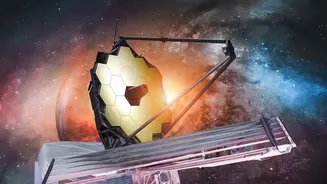
The James Webb Space Telescope is a marvel of engineering, designed to see the universe in a way no previous observatory could. Its primary advantage lies in its ability to detect infrared light. This type of light is essentially heat radiation, and many
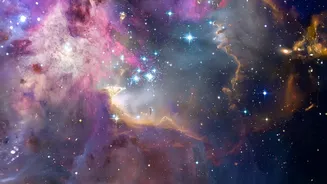
of the most interesting celestial objects, including newly forming stars and distant planets, shine brightest in the infrared spectrum. By capturing this light with unprecedented sensitivity, JWST can peer through cosmic dust clouds that obscure visible light and gather data from the farthest reaches of space. This capability is crucial for studying exoplanets, especially small, rocky ones that are much fainter and harder to analyze than their gas giant cousins.
The Science of Starlight and Shadows
One of JWST's primary methods for studying exoplanets is called transmission spectroscopy. Imagine holding a coloured filter in front of a flashlight; the light that passes through changes colour. Similarly, when an exoplanet passes in front of its host star from our perspective, the starlight filters through the planet's atmosphere. Different gases in the atmosphere absorb specific wavelengths, or colours, of light. JWST's highly sensitive spectrographs measure the starlight before and during this transit. By subtracting one from the other, scientists can see which wavelengths of light are missing. These missing slivers create a unique chemical fingerprint, allowing astronomers to identify molecules like water vapour, methane, and carbon dioxide in the planet's atmosphere.
Reading the Heat of a World
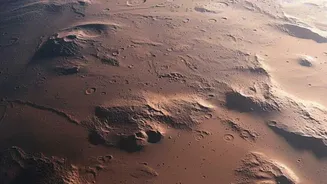
Another powerful technique is thermal emission spectroscopy. Instead of looking at the star's light, this method measures the infrared light—or heat—coming directly from the planet itself. This is often done during a 'secondary eclipse', when the planet moves behind its star. Just before it disappears, JWST measures the combined light of the star and the planet's hot day-side. When the planet is hidden, it measures the light from the star alone. The difference reveals how much heat the planet is radiating. This data can tell scientists the planet's temperature and provide clues about its surface. For instance, a planet with a significant atmosphere will distribute heat more evenly, resulting in a cooler day-side temperature than a bare rock would have.
What Webb Is Actually Finding
These techniques are already yielding fascinating, though complex, results. Take 55 Cancri e, a scorching 'super-Earth' so close to its star that its surface is likely a molten magma ocean. Webb's observations suggest the planet has a substantial atmosphere, possibly rich in carbon dioxide or carbon monoxide, which may be constantly replenished by gases bubbling from its molten interior. For the famous TRAPPIST-1 system, which hosts multiple Earth-sized planets, results are more tentative. Observations of planets like TRAPPIST-1 b and TRAPPIST-1 d suggest they have little to no atmosphere. Meanwhile, data from TRAPPIST-1 e is inconclusive, with possibilities ranging from a bare rock to a nitrogen-rich atmosphere similar to Saturn's moon Titan. These early findings highlight the immense challenge of this science; sometimes the data reveals that a planet has no atmosphere, which is a significant discovery in itself.
The Search for Habitable Worlds
While JWST has not yet definitively detected a thick atmosphere on a temperate, rocky world, it is laying the essential groundwork. The ultimate goal for many is to find 'biosignatures'—combinations of gases like oxygen and methane that could indicate the presence of life. The telescope's precision is pushing the boundaries of exoplanet characterization, moving it from a theoretical field to an observational one. Even when observations reveal a world is a bare rock or a lava planet, the data provides invaluable insights into how planets form and evolve. Recent findings are even challenging existing theories about which planets should be able to hold onto their atmospheres, suggesting some ultra-hot 'lava worlds' can maintain them while cooler planets lose them. Each observation refines our understanding of the conditions required for a planet to be truly habitable.