

Venus Shines at Its Brightest
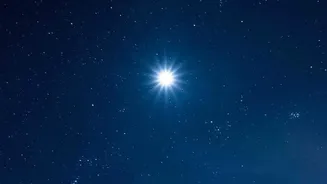
The planet Venus, often called the 'Evening Star', will be an unmissable, brilliant beacon in the western sky just after sunset. On September 22, it reaches its peak brightness for the entire year, shining at a dazzling magnitude of -4.8. What's fascinating
is that if you were to look through a telescope, you'd see it as a slender crescent. Its brightness comes from its relative closeness to Earth during this part of its orbit. For naked-eye observers, it will simply be the brightest 'star' low above the southwestern horizon. Early in the month, around September 1st and 2nd, you can also spot it passing very close to Spica, the brightest star in the constellation Virgo.
A Meteor Shower From Perseus
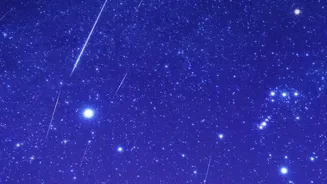
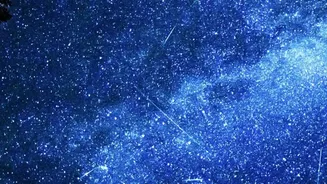
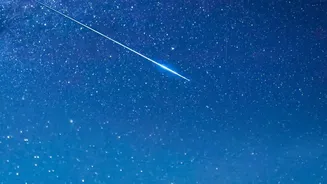
While the famous August Perseids get most of the attention, September has its own, quieter meteor shower: the September Epsilon Perseids. Active from September 5 to 21, this shower is expected to peak on the night of September 9. With only a thin crescent moon, viewing conditions will be excellent for spotting these 'falling stars'. You can expect to see around 5 to 8 meteors per hour radiating from the constellation Perseus. For the best view, find a dark spot away from city lights, let your eyes adjust for about 20 minutes, and look towards the northern sky. The show is best after 10 or 11 p.m. local time.
The Autumnal Equinox Arrives
On September 23, the Sun will shine directly over the Earth's equator, marking the autumnal equinox in the Northern Hemisphere. This is the official start of autumn, a moment when day and night are nearly equal in length everywhere on Earth. For stargazers, the equinox is a welcome milestone because it signals the beginning of longer nights, providing more time to explore the cosmos. In India, the equinox occurs in the early morning, around 5:35 AM IST. Culturally, this time is celebrated in various ways around the world, often as a harvest festival acknowledging the changing seasons.
The Famous Harvest Moon
September's full moon, which reaches its peak on September 26, is the famous Harvest Moon. It gets its name because it is the full moon closest to the autumnal equinox, and its bright light historically helped farmers extend their workday to harvest crops. A unique feature of the Harvest Moon is that for several nights in a row, it rises around the same time shortly after sunset, rather than rising about 50 minutes later each night as usual. This year, the Harvest Moon will share the sky with the planet Saturn, which will be nearing its own peak brightness, making for a beautiful pairing.
A Parade of Planets
September is a fantastic month for planet-spotting. Besides the brilliant Venus in the evening, other planets are putting on a show. Saturn rises a little earlier each evening and will be visible for most of the night. Jupiter and Mars will be visible in the pre-dawn sky, rising in the east. Between September 6 and 9, you can watch the waning crescent moon pass by both Mars and Jupiter before sunrise, creating a lovely celestial line-up. On September 14, a very thin crescent moon will have a close encounter with Venus just after sunset, a beautiful sight for observers across India and Asia. While all these are visible with the naked eye, a simple pair of binoculars can enhance the view, revealing the moons of Jupiter or the distinct colours of the planets.