




The Great Data Traffic Jam
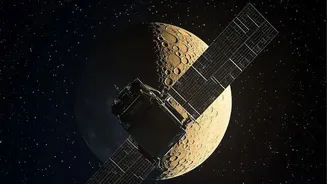
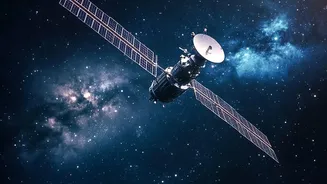
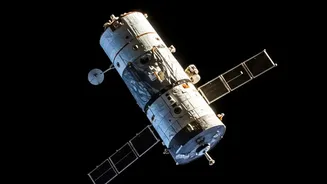
Space is getting crowded with satellites, and each one is a powerful data-gathering machine. They capture high-resolution images and measurements critical for everything from tracking climate change to managing city infrastructure. The problem is that
all this raw data—totalling millions of gigabytes every day—has to be sent back to Earth via limited radio frequency links. This creates a massive data bottleneck, much like trying to download hundreds of HD movies over a dial-up connection. As a result, there are significant delays between when data is captured and when it can be used. Furthermore, transmitting vast amounts of information is costly and consumes precious bandwidth, and much of the downloaded data, like images of dense cloud cover, is often unusable anyway.
AI as the Onboard Analyst
The game-changing solution is to process data where it's collected: in space. This is a form of 'edge computing', where artificial intelligence models are run directly on the satellite. Instead of beaming terabytes of raw imagery to a ground station, the satellite's onboard AI can analyze it in real time. It can be trained to look for specific events or objects of interest—such as wildfires, floods, or ships at sea—and transmit only the relevant, processed insights. This drastically reduces the amount of data that needs to be sent, freeing up bandwidth and allowing ground teams to receive critical information in minutes, not hours or days. Companies like Loft Orbital and Planet are already designing their next-generation satellites with powerful onboard processors from companies like NVIDIA to make this a core function.
Smarter Science, Faster Response
On-orbit AI is already delivering tangible benefits. For disaster management, a satellite can autonomously detect signs of flooding or wildfire damage in its imagery and immediately send alerts to emergency responders on the ground. In agriculture, AI can monitor crop health and detect early signs of disease, helping to ensure food security. For scientists, it accelerates discovery. AI algorithms can sift through telescope data to find new exoplanets or analyze hyperspectral imagery from Mars to identify minerals, flagging only the most promising findings for human review. NASA's ExoMiner system, for example, used deep learning to identify 301 new exoplanets from existing Kepler Space Telescope data.
The Next Frontier: Autonomous Exploration
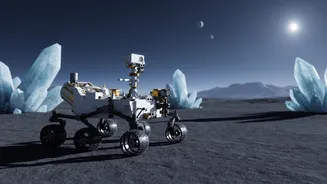
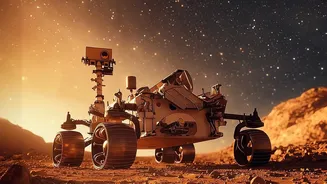
For deep space missions, on-orbit AI is not just a benefit—it's a necessity. Communication with a rover on Mars can have a delay of up to 20 minutes each way, making real-time human control impossible. This is why NASA’s Perseverance and Curiosity rovers rely heavily on AI to navigate the Martian surface autonomously. Their onboard systems analyze the terrain, identify hazards like rocks and steep slopes, and plot safe routes without waiting for commands from Earth. This capability is crucial for future exploration of distant moons and planets, where spacecraft will need to make independent decisions to carry out their scientific missions, manage their own systems, and respond to unexpected events.
Challenges in the Final Frontier
Running sophisticated AI in space is not without its challenges. The hardware must be 'radiation-hardened' to survive the harsh environment, which often means using processors that are generations behind their commercial counterparts on Earth. These systems also face extreme temperatures and have strict limitations on size, weight, and power consumption. Furthermore, updating AI models after they've been launched into orbit can be difficult due to limited uplink bandwidth. Another challenge is ensuring the AI's decisions can be trusted, as there isn't yet a universal standard for validating AI flight software for critical missions. Despite these hurdles, agencies like NASA and the European Space Agency are actively developing more powerful and resilient space-grade computers to handle the next wave of autonomous missions.