







Ancient Roots and Spiritual Goals
Yoga's origins trace back thousands of years in India, first mentioned in ancient sacred texts. The practice was not about physical fitness but about uniting the mind, body, and spirit to achieve enlightenment. The foundational text, Patanjali's Yoga Sutras,
compiled around 400 CE, outlines an eight-limbed path. This path is a guide to living a meaningful and purposeful life, with physical postures (asanas) being just one component. The primary focus was on mental discipline, described as the calming of the fluctuations of the mind. This early form of yoga was a comprehensive philosophy and a deep, internal practice aimed at self-realisation.
The First Wave to the West
Yoga's journey to the West began in earnest in the late 19th century, largely thanks to Swami Vivekananda. In 1893, he addressed the Parliament of the World's Religions in Chicago, introducing Indian philosophies to a captivated American audience. He presented yoga not as a series of physical poses, but as a 'science of the mind'—a rational, universal path to spiritual growth. Vivekananda primarily spoke of Raja Yoga, the path of meditation and mental control, and categorised the practice into four main streams: action (Karma), devotion (Bhakti), knowledge (Jnana), and meditation (Raja). His compelling lectures shattered myths and positioned yoga as a sophisticated psychological and spiritual system, opening the door for future teachers from India.
The Shift Towards the Physical
The 20th century marked a significant shift in how yoga was practiced and perceived, with a growing emphasis on asana. This change was heavily influenced by pioneers like B.K.S. Iyengar. Iyengar, who began his journey as a sickly child, transformed his health through intense physical practice. He developed a unique method, now known as Iyengar Yoga, that focused on precise physical alignment in each posture. A key innovation was his use of props like blocks, straps, and blankets to help students of all abilities achieve poses safely and effectively. This made the physical practice more accessible and therapeutic. Iyengar's book 'Light on Yoga' became a global guide, and his television appearances introduced a visually dynamic form of yoga to the West, cementing the link between yoga and physical well-being.
The Counter-Culture Embrace
By the 1960s and 70s, the West was primed for a spiritual revolution, and yoga was at its heart. The lifting of strict immigration quotas in the US in 1965 allowed a new wave of Indian gurus to travel and teach. The counter-culture movement, with its emphasis on self-exploration, Eastern mysticism, and alternative lifestyles, fully embraced yoga. A symbolic moment was in 1969 when Swami Satchidananda opened the Woodstock festival, greeting the massive crowd and leading them in chanting. During this era, yoga became a tool for personal discovery and a symbol of peace and mindfulness, moving further into the cultural mainstream. It was no longer just a niche spiritual practice but a way for many to find meaning outside of traditional structures.
The Modern Wellness Industry
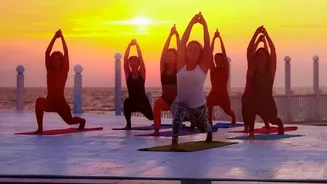
In the 21st century, yoga completed its transformation into a global lifestyle industry worth billions of dollars. What was once a free, spiritual practice is now commercialized, with yoga studios, branded apparel, expensive mats, and wellness retreats forming a massive market. This boom has made yoga incredibly accessible, with styles ranging from 'Power Yoga' and 'Hot Yoga' to gentler, restorative forms. However, this commercialization has sparked debate. Critics argue that the focus on the physical 'yoga body' and the high cost can dilute its spiritual essence and raise questions about cultural appropriation. Many modern teachers are now trying to reconnect practitioners with yoga's philosophical roots, emphasizing that it is more than just a workout.