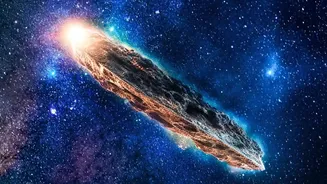







The solar system just got a little more crowded. Astronomers have announced the discovery of a potential new dwarf planet, provisionally named 2026 ED138, in the icy depths beyond Neptune. This finding is one of the first major discoveries from the powerful
Vera Rubin Observatory in Chile, showcasing the facility's incredible potential to map our cosmic neighbourhood in unprecedented detail.
A New Neighbour in the Kuiper Belt
The object, 2026 ED138, was detected lurking in the Kuiper Belt, a vast, disc-shaped region of icy bodies left over from the formation of the solar system. This cosmic junkyard, which begins beyond the orbit of Neptune, is home to thousands of known objects, including Pluto. Initial observations suggest 2026 ED138 is a significant find, with an estimated diameter between 370 and 930 miles. For context, Pluto, the most famous resident of the Kuiper Belt, has a diameter of just over 1,400 miles. The new candidate also has a peculiar, highly tilted orbit, taking it on a path angled about 25 degrees from the main plane where the eight major planets travel. Astronomers were able to spot the faint, moving dot by using powerful software to analyse the stream of images coming from the Rubin Observatory, a task likened to finding a needle in a cosmic haystack.
The Dwarf Planet Checklist
So, why is it only a 'potential' dwarf planet? The term comes with a specific set of criteria laid out by the International Astronomical Union (IAU) in 2006, the same year Pluto was reclassified. To be a dwarf planet, an object must do three things: orbit the Sun, be massive enough for its own gravity to pull it into a nearly round shape, but not have enough gravitational muscle to 'clear its orbital neighbourhood' of other objects. While 2026 ED138 clearly orbits the Sun, astronomers still need more observations to confirm its shape. Proving an object is in 'hydrostatic equilibrium'—the technical term for being round due to gravity—is a difficult but crucial step. This requirement is what separates dwarf planets from the countless lumpy, irregularly shaped asteroids and other small solar system bodies. Further study will be needed to see if this new object makes the grade.
A Game-Changer on a Mountaintop
This discovery is as much about the technology as it is about the object itself. The Vera C. Rubin Observatory, perched high in the Chilean Andes, is a revolutionary new tool for astronomy. Its main mission is a decade-long project called the Legacy Survey of Space and Time (LSST), which will create the most comprehensive movie of the southern sky ever made. At its heart is the world's largest digital camera, a 3.2ndigapixel behemoth capable of imaging a patch of sky 45 times the size of the full moon in a single shot. Every 40 seconds, it takes a new, incredibly deep image, generating a massive 10 terabytes of data every night. This rapid, wide, and deep scanning ability makes it a perfect machine for finding faint, moving objects like those in the Kuiper Belt, a task that was painstakingly slow with older telescopes. Discoveries like 2026 ED138 are expected to be the first of many, with the observatory predicted to increase the catalogue of known solar system objects by a factor of 10 to 100.
Why Finding More Rocks Matters
Each new discovery in the Kuiper Belt is another piece of the puzzle of our solar system's history. These icy bodies are pristine remnants from its formation 4.6 billion years ago,
and studying their orbits,
compositions,
and distribution gives us direct clues about how the planets formed and migrated to their current positions.
Creating a more complete census of these distant worlds helps astronomers refine their models of planetary evolution.
Furthermore,
the orbits of these smaller bodies can sometimes hint at the gravitational influence of something much larger.
Some astronomers believe the peculiar clustering of several Kuiper Belt objects points to the existence of a yetundiscovered,
fullsized 'Planet Nine' lurking in any far reaches of our solar system.
While
the discoverers of
2026 ED138 note their finding neither confirms nor denies this theory,
every new object provides another data point for search.