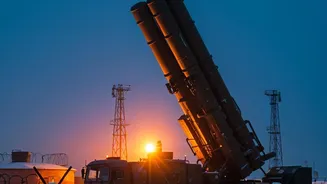








From 'Expired' to 'Extended'
In the midst of a high-intensity conflict, the term 'munitions reclassification' sounds like dry bureaucracy, but its implications are profound. It refers to the process of taking munitions that are at or near their original 'best-by' date and, after
rigorous testing, certifying them for continued use. This isn't about recklessly sending faulty weapons to the front lines. The US Department of Defense has a long-standing Stockpile Reliability Program (SRP) designed for this exact purpose. Through scientific analysis of propellants, electronics, and structural integrity, engineers can determine if a missile or artillery shell can have its service life safely extended. Recent testimony confirmed that munitions previously deemed unserviceable have been reclassified and used in the ongoing conflict, a move that unlocks vast, otherwise dormant inventories. This process, also known as Shelf-Life Extension, is a pragmatic solution to a pressing problem, but it’s one that inevitably comes with calculated risks.
A War of Attrition and Logistics
The decision to lean on older stockpiles is not made in a vacuum. The current war has seen an unprecedented expenditure of high-end precision weapons, such as Tomahawk cruise missiles and various interceptors. Reports indicate that the rate of consumption has been so high that it has exposed the limitations of the Western defense industrial base, which is not structured for a sustained, large-scale conventional war. Producing a complex missile can take up to two years, and annual production numbers pre-war were a fraction of what is now being used monthly. This logistical strain creates a critical gap between consumption and production. Reclassifying existing munitions is one of the few ways the military can bridge this gap without reducing operational tempo, effectively turning warehoused assets from a previous era into viable options for today's battlefield.
The Inherent Risks and Questions
While the Pentagon insists its shelf-life extension programs are safe and based on robust testing, using older munitions is not without risk. Over time, chemical stabilizers in propellants can degrade, seals can fail, and electronic components can become unreliable. These issues can lead to a range of failures, from a 'dud' round that simply fails to detonate, to a 'squib' load that doesn't have enough force to leave the barrel, or, in the worst-case scenario, a catastrophic malfunction that endangers the user. Even if the failure rate is statistically small, on a modern battlefield where a single missile’s success can determine an operation’s outcome, reliability is paramount. The questions being raised are not just about safety, but also about effectiveness. Will an extended-life missile perform with the same precision as a new one? Is a slight decrease in reliability an acceptable trade-off for maintaining supply?
A Sign of Deeper Strategic Challenges
Ultimately, the reclassification of munitions is a symptom of a much larger strategic issue: the mismatch between the demands of modern warfare and the capacity of the defense industry to meet them. For decades, Western military procurement focused on smaller numbers of highly advanced, expensive 'silver bullet' weapons, assuming short, decisive conflicts. The protracted wars in Ukraine and now Iran have shown that large-scale warfare consumes vast quantities of even basic munitions, let alone complex guided weapons. The current situation highlights a potential vulnerability in a peer-level conflict with a power like China, which has a massive state-controlled industrial base. This policy, born of necessity, serves as a wake-up call that a nation’s military might is not just measured by the sophistication of its weapons, but by its ability to produce and sustain them under the immense pressures of war.