





Our universe is filled with mysteries, but none are as profound as dark matter, the invisible substance making up most of its mass. Deep underground, scientists are hunting for clues, not by seeing something new, but by watching for the impossible.
Our Incomplete Cosmic Rulebook
For
decades, the Standard Model of particle physics has been the reigning champion of physics. It's a comprehensive 'rulebook' that describes the fundamental particles and forces that make up everything we can see and touch. It successfully explains how quarks form protons and neutrons, how electrons orbit atoms, and how particles like the Higgs boson give other particles mass. However, the Standard Model has some significant gaps. It cannot explain gravity, and crucially, it has no place for dark matter or dark energy, which together are thought to constitute about 95% of the universe. This glaring omission tells physicists that the Standard Model, while successful, is incomplete. There must be new particles and forces out there waiting to be discovered, and finding them is one of the biggest goals in science.
The LHC's Specialist Detective
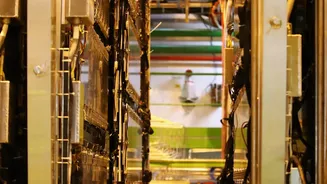
Enter the Large Hadron Collider (LHC) at CERN, the most powerful particle accelerator ever built. While experiments like ATLAS and CMS are designed to find new, heavy particles by smashing protons together with immense energy, the LHCb (Large Hadron Collider beauty) experiment plays a different game. Instead of looking for new particles directly, LHCb is a specialist detective, designed to study one type of particle with incredible precision: the 'beauty' quark. Beauty quarks are exotic and unstable, surviving for only about a trillionth of a second before decaying into other, lighter particles. The LHCb detector is a 21-metre-long spectrometer that precisely tracks the flight paths and properties of the particles that emerge from these decays. The goal is to look for indirect evidence of new physics by seeing if these decays follow the Standard Model's rules perfectly.
A Hunt for Impossible Events
The key lies in searching for 'rare decays'. These are processes that, according to the Standard Model, should almost never happen. In early November 2026, researchers at LHCb announced the first evidence for one such process: the decay of a particle called a Bd meson into two smaller particles called muons. The Standard Model predicts this should happen only about once in every ten billion times a Bd meson decays. After decades of searching, scientists have finally found evidence for this decay, using an upgraded detector and advanced machine learning to filter the signal from background noise. The result has a statistical significance of 3.2 sigma, which is considered 'evidence' but falls short of the 5-sigma 'gold standard' for a confirmed discovery. If these rare decays happen more or less often than predicted, it would be a huge crack in the Standard Model, suggesting an unknown particle or force is interfering with the process.
The Dark Matter Connection
So, how does a one-in-ten billion event connect to the vast mystery of dark matter? The link is indirect but powerful. Theories suggest that if new, undiscovered particles exist—such as candidates for dark matter or particles that interact with it—they could meddle in these highly sensitive quantum processes. Even if these particles are too heavy to be created directly at the LHC, their existence could subtly change the rate at which rare decays occur. Think of it like trying to detect a hidden planet. You can't see it, but you can infer its presence by observing the wobble it causes in its star's orbit. Similarly, by precisely measuring these rare decays, physicists are looking for the 'wobble' that could betray the existence of new physics. The current measurement for the Bd decay is consistent with the Standard Model's prediction, but it places powerful new constraints on theories that go beyond it. It's a crucial step in narrowing down the search for where new physics, and potentially dark matter, might be hiding in what some scientists are calling the 'zeptoverse'—a realm of incredibly small scales.