



The Philosophy of Slow Movement
Before beginning, it's important to understand the guiding principle: listen to your body. These exercises are designed to be gentle and should never be pushed to the point of sharp pain. The goal is to move through a comfortable range of motion to improve
circulation and relieve tension, not to force a deep stretch. Prolonged sitting shortens some muscles while weakening others, leading to predictable patterns of discomfort in the neck, shoulders, and lower back. By integrating small, slow movements throughout your day, you can counteract this static posture and reduce stiffness. Think of these as movement snacks, not a full workout. Frequency is more important than intensity.
1. Gentle Neck Tilts and Rotations
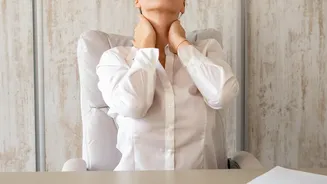
Neck stiffness is one of the most common complaints for desk workers. To gently relieve this, sit tall in your chair with your feet flat on the floor. Slowly tilt your head, bringing your right ear toward your right shoulder. Hold for 15-20 seconds, feeling a gentle stretch along the side of your neck, but do not force it. Return to the center and repeat on the left side. Next, slowly turn your head to look over your right shoulder, holding for a few seconds before returning to the center and repeating on the left. These movements help release the tension built from staring at a screen.
2. Soothing Shoulder Shrugs and Rolls
Our shoulders often carry stress, creeping up towards our ears as the day progresses. To release this, perform simple shoulder shrugs. While sitting or standing, inhale and lift your shoulders up toward your ears. Hold for three seconds, then exhale and let them drop completely. Repeat this 5-10 times. Afterwards, gently roll your shoulders backward in a circular motion for five repetitions, and then forward for five repetitions. This helps to loosen the upper trapezius muscles and reduce feelings of tightness across your upper back.
3. Seated Cat-Cow for Spinal Mobility
This gentle yoga pose is adapted for your chair to awaken a stiff spine. Sit on the edge of your seat with your hands on your knees. On an inhale, gently arch your back, push your chest forward, and look slightly up toward the ceiling (the 'cow' position). On your exhale, round your spine, tucking your chin to your chest and letting your back curve (the 'cat' position). Alternate slowly between these two positions 8-10 times. This movement helps to improve flexibility in the lower and upper back, which often gets compressed during long periods of sitting.
4. Wrist and Finger Extensors
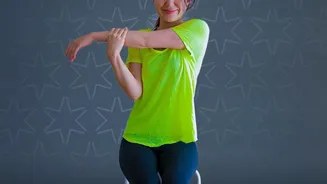
Typing and using a mouse can lead to tightness in the forearms and wrists. To counter this, extend one arm straight out in front of you with your palm facing up. With your other hand, gently bend the extended hand downwards, pulling the fingers towards the floor. You should feel a mild stretch on the top of your forearm. Hold for 20-30 seconds, ensuring you don't feel any sharp pain. Release and then repeat with the palm facing down, gently pulling your fingers toward your body to stretch the other side of your forearm. Switch hands and repeat the sequence.
5. Seated Spinal Twist
A gentle twist can help relieve lower back tension. Sit tall in your chair with both feet flat on the floor. Keeping your hips square, slowly twist your upper body to the right. You can place your left hand on your right knee to gently deepen the stretch. Look over your right shoulder if it’s comfortable for your neck. Hold for 15-30 seconds while breathing deeply, then slowly return to the center and repeat on the left side. This rotation mobilizes the thoracic spine, a common area of stiffness.
6. Seated Figure-Four Hip Stretch
Sitting for hours can tighten the hip flexors and glutes, which can contribute to lower back pain. To stretch this area, sit tall and cross your right ankle over your left knee, creating a 'figure-four' shape. Keep your right foot flexed to protect the knee. You may already feel a stretch in your right hip. For a deeper, but still gentle, sensation, you can slowly lean forward with a straight back until you feel a comfortable stretch. Hold for 20-30 seconds, breathing evenly, then switch to the other side.
7. Ankle Rotations and Calf Raises
Don't forget your lower legs, as circulation can become sluggish after hours of sitting. While seated, lift one foot off the floor and slowly rotate your ankle clockwise 10 times, then counter-clockwise 10 times. This lubricates the ankle joint. Then, either sitting or standing, place your feet flat on the floor. Slowly raise your heels up as high as you can, pausing at the top, and then slowly lower them. Repeat 10-15 times. This simple movement, also known as a calf raise, helps to pump blood back up your legs and prevent stiffness.