






Meet India’s New Watcher
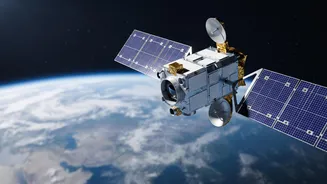
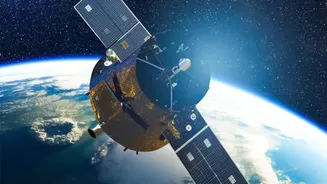
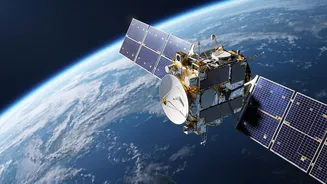
The satellite at the heart of this development is designated EOS-05, also known as GISAT-1A. Scheduled for a landmark launch on September 4, 2026, this spacecraft is not just another addition to India's impressive satellite fleet; it represents a fundamental
leap in our Earth observation capabilities. It is set to be India's first imaging satellite placed in a geosynchronous orbit, a position that unlocks the ability for persistent, 24/7 monitoring of the Indian subcontinent. Unlike its predecessors that passed over an area periodically, EOS-05 will act as a fixed, dedicated observer, a true 'eye in the sky' for the nation.
The 36,000 Kilometre Advantage
The number 36,000 kilometres is the key to this satellite's extraordinary capability. At this altitude, a satellite enters a geostationary orbit (GEO), where its orbital period matches the Earth's rotation. From our perspective on the ground, the satellite appears to hover motionless over a single point on the equator. Most of India’s previous Earth observation satellites, like those in the Cartosat and RISAT series, operate in Low Earth Orbit (LEO), just a few hundred kilometres up. While powerful, LEO satellites are like guards on patrol; they get a detailed look at a location but only for a brief moment before they have to circle the globe to return. A GEO satellite, in contrast, is like a security camera fixed on the main gate, providing a continuous, unbroken view of a vast area. This allows for the near-real-time tracking of events as they unfold.
A Revolution in Weather Forecasting
For a country frequently impacted by extreme weather, this constant watchfulness is a game-changer. The satellite’s advanced imagers can monitor the rapid development of cyclones, thunderstorms, and cloudbursts, providing data crucial for accurate and timely warnings. It will be capable of imaging a selected region of interest every five minutes and the entire Indian landmass every 30 minutes. This rapid-scan ability is vital for tracking fast-moving weather systems, helping disaster management agencies to issue alerts, evacuate vulnerable populations, and save precious lives. Furthermore, its instruments can help in monitoring forest fires, floods, and changes in vegetation, making it an invaluable tool for environmental management and climate studies.
Bolstering National and Border Security
Beyond its civilian applications, EOS-05 is a significant asset for national security. The ability to maintain a persistent watch over the Indian subcontinent and its surrounding regions offers a powerful strategic advantage. The satellite can be tasked to monitor sensitive border areas, track movements across land and sea, and keep an eye on strategic assets, all in near-real-time. While lower-orbit satellites provide high-resolution snapshots, EOS-05 will deliver the bigger picture, continuously. This capability for 'always-on' surveillance can help security forces detect changes and patterns that might otherwise be missed, enhancing India's overall defence and intelligence-gathering framework.
A Mission of Resilience
The upcoming launch of EOS-05 also tells a story of perseverance. The mission is, in effect, a second attempt after its predecessor, GISAT-1 (also known as EOS-03), was lost during a launch failure in August 2021 due to a technical issue with the GSLV rocket. For ISRO, successfully placing this advanced satellite into its intended orbit will not only be a major technological achievement but also a powerful demonstration of the agency’s resilience. It signifies a commitment to mastering complex technologies and overcoming setbacks to achieve goals of national importance. With this mission, India is set to join an elite group of nations operating geostationary imaging satellites, reinforcing its position as a leading space-faring power.