




1. Gaganyaan: India's Human Spaceflight Mission
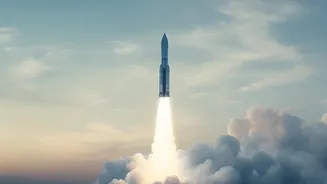
The most anticipated mission is Gaganyaan, India's inaugural human spaceflight program. The objective is to launch a crew of three astronauts into a 400-kilometer orbit for a three-day mission and return them safely to Earth. Following a series of crucial
uncrewed test flights scheduled through 2026, the first crewed mission is expected around 2027 or 2028. Successful qualification tests for the crew module's safety systems are already underway, paving the way for this historic flight. This monumental undertaking will make India the fourth nation to independently send humans into space, opening the door for future projects like the Bharatiya Antariksh Station.
2. NISAR: A Joint Earth-Watching Powerhouse
A landmark collaboration between NASA and ISRO, the NISAR (NASA-ISRO Synthetic Aperture Radar) mission is set to be the world's most expensive Earth-imaging satellite. Launched in July 2025, this satellite uses advanced dual-frequency radar to monitor our planet's surface in unprecedented detail, day or night and in all weather conditions. It will track subtle changes in Earth's ecosystems, ice sheets, and crust, providing critical data for understanding climate change, managing natural disasters like earthquakes, and monitoring agricultural resources. Its 12-day repeat cycle will create a comprehensive time-lapse of the planet's processes.
3. Shukrayaan-1: Unveiling the Secrets of Venus
After conquering the Moon and Mars, ISRO is setting its sights on our other planetary neighbour, Venus. The Shukrayaan-1 mission, India's first orbiter to Venus, is slated for a 2028 launch. Often called Earth's "twin sister" due to its similar size, Venus is a world of extreme heat and a toxic atmosphere. Shukrayaan-1 will carry a suite of scientific instruments to study its mysterious surface and dense atmosphere, including a ground-penetrating radar to investigate its subsurface geology. This mission will provide valuable insights into why Venus followed such a different evolutionary path from Earth.
4. Mangalyaan-2: India's Return to the Red Planet
Building on the stunning success of the first Mars Orbiter Mission (MOM), ISRO is planning an even more ambitious sequel. Mangalyaan-2, or MOM-2, will not just orbit Mars but will attempt India's first landing on the Red Planet. The mission concept includes a lander, a rover, and even a helicopter, drawing parallels to NASA's Perseverance and Ingenuity missions. The goal is to conduct on-ground studies of Martian geology and atmosphere. A successful landing would make India only the fourth country to achieve this feat, representing a massive leap in its interplanetary capabilities.
5. LUPEX: A Joint Hunt for Lunar Water
India's lunar exploration continues with the Lunar Polar Exploration Mission (LUPEX), a joint project with the Japan Aerospace Exploration Agency (JAXA). Scheduled for no earlier than 2028, this mission will target the Moon's intriguing south pole. The primary objective is to search for and analyze water ice in the permanently shadowed regions. For this mission, ISRO will provide the lander, while JAXA will contribute the sophisticated rover. The findings could be crucial for establishing a sustainable human presence on the Moon by unlocking a key resource.
6. SPADEX: Mastering the Art of Space Docking
The Space Docking Experiment (SPADEX) is a crucial technology demonstration mission designed to master the complex process of joining two spacecraft in orbit. The mission involves two small satellites—a 'Chaser' and a 'Target'—that will autonomously rendezvous and dock. This capability is a fundamental building block for more advanced space operations. Mastering docking is essential for building and servicing the planned Bharatiya Antariksh Station, conducting in-orbit satellite refueling, and executing complex interplanetary missions like sample returns. SPADEX will make India the fourth nation with this vital technology.
7. A New Fleet of Earth observers and Commercial Rockets
Alongside these flagship missions, ISRO is accelerating its launch cadence for a variety of other satellites. This includes new Earth Observation Satellites (EOS) to provide near real-time imagery for disaster management and resource monitoring. The agency is also planning to launch multiple communication satellites to boost India's digital infrastructure. Furthermore, a new launch complex at Kulasekarapattinam is set to become operational, designed to support an increasing number of commercial launches and cater to the growing private space sector, cementing India's position as a major player in the global space economy.