

A Storm for the Ages
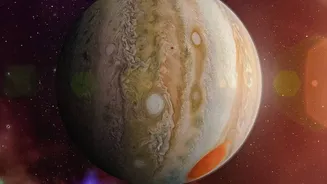
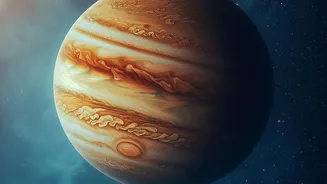
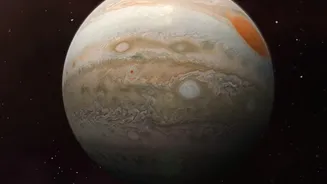
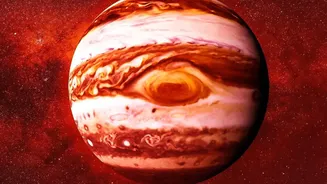
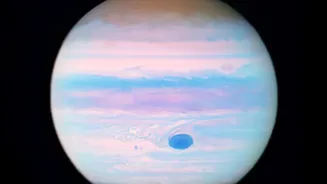
For as long as humans have pointed telescopes at Jupiter, the Great Red Spot has been its most defining feature. It is an enormous anticyclonic storm, a high-pressure system rotating counterclockwise in the planet's southern hemisphere. First observed
in detail in the late 19th century, this vortex was once wide enough to swallow three Earths side-by-side. For centuries, it has raged with wind speeds far exceeding any hurricane on our own planet, making it the largest and most powerful storm known in our solar system. But this seemingly permanent feature is proving to be more dynamic than ever imagined.
An Ever-Changing Giant
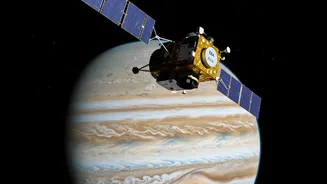
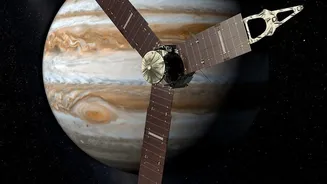
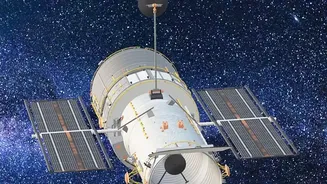
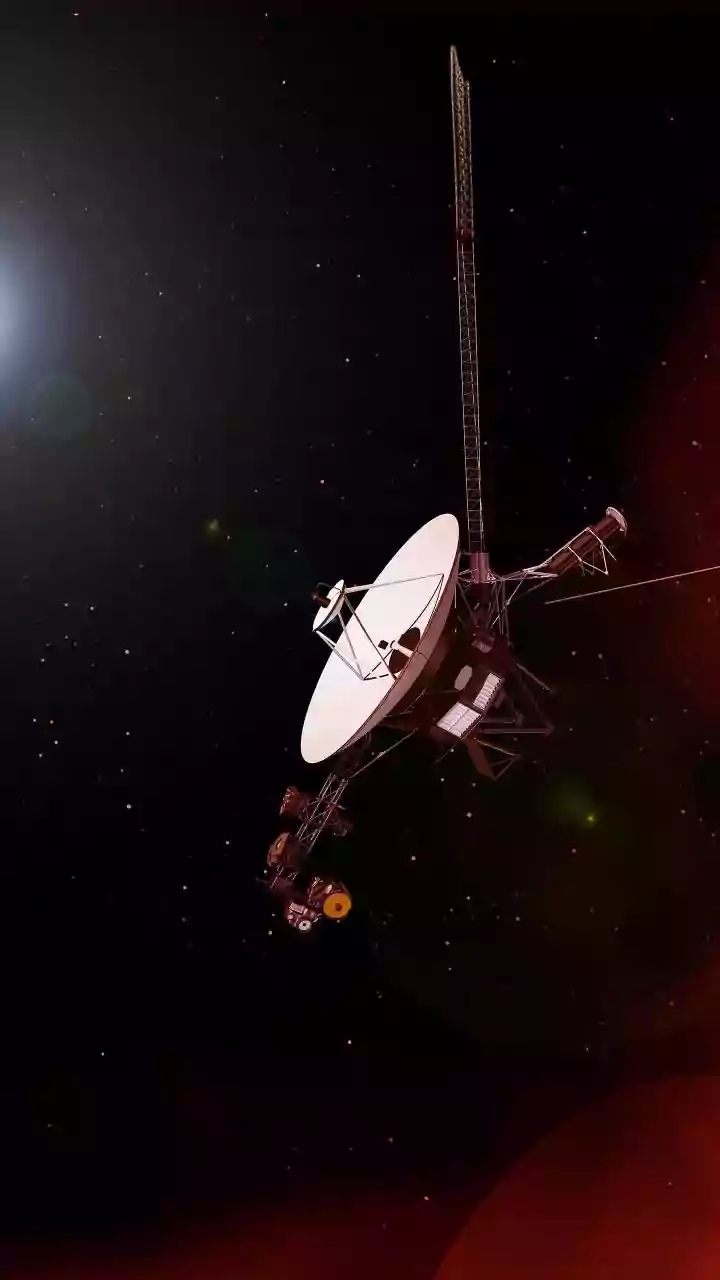
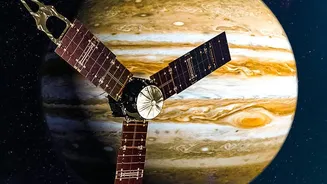
Recent observations, particularly from NASA's Juno spacecraft and the Hubble Space Telescope, have provided a stunningly detailed look at the storm's evolution. These advanced planetary cameras confirm what astronomers have been tracking for decades: the Great Red Spot is shrinking. Since the Voyager probes flew by in 1979, the storm's width has decreased by about a third. Today, it is only about 1.3 times the width of our planet. The rate of shrinkage has varied, sometimes accelerating and other times slowing, but the long-term trend is undeniable. The storm is not only getting smaller but also changing its shape, becoming more circular and taller as it contracts.
What's Driving the Change?
Scientists are working to understand the forces behind these transformations. One leading theory suggests the Great Red Spot is essentially being starved. Research and numerical simulations indicate that the colossal storm maintains its strength by feeding on smaller, nearby storms. A decrease in the frequency or intensity of these smaller storms could be depriving the Great Red Spot of the energy needed to maintain its vast size, causing it to shrink. Another fascinating discovery from NASA's Juno mission is the storm's surprising depth. Data from its microwave radiometer revealed that the storm's roots penetrate deep into Jupiter's atmosphere, extending as far as 500 kilometers below the cloud tops—far deeper than scientists had expected. This incredible depth suggests the storm is linked to atmospheric dynamics far below the visible surface.
A Closer Look Reveals More
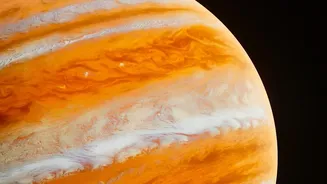
The high-detail images have also uncovered other curious features. At times, the storm's once-intense reddish-orange hue has faded, and its core has become less distinct. Scientists have also observed unusual, wispy filaments twisting and rotating within the vortex, caught in winds that can exceed 500 kilometers per hour. While the storm's iconic color is still not fully understood, it's thought to be caused by chemical compounds like ammonia reacting with solar radiation in the upper atmosphere. The changes in color and internal structure provide valuable data points for scientists modeling the complex chemistry and physics at play.
Why Jupiter's Weather Matters
Studying the Great Red Spot is more than just planetary sightseeing. Understanding the dynamics that govern Jupiter's massive storms helps scientists refine their models of atmospheric physics, which can be applied to planets in our solar system and beyond. The principles governing weather on this gas giant, though extreme, share similarities with those on Earth. By observing how this centuries-old storm evolves, shrinks, and potentially disappears, we gain invaluable insights into the life cycle of planetary weather systems. It's a real-time laboratory for atmospheric science on a scale that is impossible to replicate.