




The Ultimate Speed Limit
To understand this cosmic time travel, we need to start with the speed of light. It’s the fastest thing in the universe, zipping through the vacuum of space at a staggering 300,000 kilometres per second. At this speed, a beam of light could circle the Earth
more than seven times in a single second. It seems instantaneous, and for our daily lives, it practically is. But space is unimaginably vast. The distances between stars are so enormous that even at this blistering pace, light takes years, centuries, or even millennia to travel from its source to our planet. This is the fundamental reason why the night sky is a history book written in light.
What Exactly Is a Light-Year?
Because the distances are so large, astronomers use a special unit of measurement: the light-year. It’s a common point of confusion, but a light-year is a measure of distance, not time. It is simply the distance that light travels in one year. To put that into perspective, one light-year is equivalent to about 9.5 trillion kilometres. The closest star to our Sun, Proxima Centauri, is about 4.2 light-years away. This means the light we see from it tonight actually left the star over four years ago. When we look at Proxima Centauri, we are seeing it as it was during that time. Every star you see has a similar, and often much longer, delay.
Messages from Centuries Past
The headline’s promise of starlight from “centuries ago” is not an exaggeration. Take Polaris, the famous North Star. It sits approximately 433 light-years from Earth. The faint, guiding light from Polaris that reaches a telescope in India tonight began its journey around the year 1590. This was a time when the Mughal Empire was flourishing under Akbar. The light has been travelling across the cosmos ever since, long before the invention of the telescope that would one day see it arrive. Another famous example is Betelgeuse, the bright reddish star in the constellation Orion. It’s over 640 light-years away. The light we see from it left around the time the Tughlaq dynasty was declining in the Delhi Sultanate. We are, in a very real sense, seeing echoes of a distant past.
A Sky Full of Ghosts?
This cosmic time lag has a fascinating and slightly eerie implication. Since we are seeing stars as they were hundreds or thousands of years ago, it’s possible that some of the stars we see in our sky tonight no longer exist. A massive star might have exploded in a supernova, or a smaller star could have burned out, but we wouldn’t know it yet. The light from its final moments is still hurtling towards us, but the news of its death hasn’t arrived. Betelgeuse is a prime candidate for this. As a red supergiant, it’s due to go supernova sometime in the next 100,000 years. It could have exploded 500 years ago, and we would be completely unaware. For the next ~140 years, we would continue to see it shining, a ghost of light from a star that is already gone.
Beyond the Stars
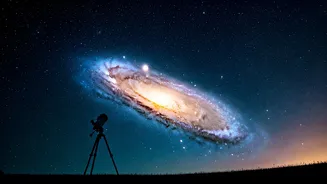
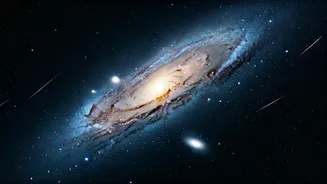
This effect isn’t limited to individual stars. When we look at the Andromeda Galaxy, the closest major galaxy to our own Milky Way, we are seeing light that is 2.5 million years old. The photons hitting our eyes began their journey when early human ancestors were first walking the Earth. Every image captured by deep space telescopes like the James Webb is a glimpse into an even more ancient past, showing us galaxies as they were billions of years ago, not long after the Big Bang itself. The entire universe is a layered tapestry of time, and our view from Earth is a composite image of countless different eras all appearing at once.