






What is Microgravity and Why Does It Matter?
Microgravity, or 'zero-g', is the condition of apparent weightlessness experienced by objects in freefall, such as a satellite orbiting Earth. On the ground, gravity's constant pull creates phenomena like convection, where hot fluids rise and cold fluids sink,
and sedimentation, where denser particles settle at the bottom of a mixture. These forces, which we take for granted, can interfere with delicate physical and biological processes. In microgravity, these effects are nearly eliminated. Without gravity-driven convection and sedimentation, it becomes possible to observe and manipulate materials in their purest form. This allows for the creation of more perfect crystals, flawlessly mixed alloys, and uninhibited cellular growth, opening doors for breakthroughs that are difficult or impossible to achieve on Earth.
The New Commercial Gateway to Space
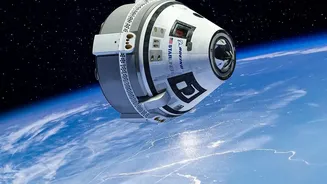
Historically, accessing microgravity meant securing a spot on a government-funded mission to the International Space Station (ISS), a complex and expensive process. Today, a growing number of private companies are democratizing access. Companies like Blue Origin offer suborbital flights on their New Shepard rocket, providing researchers several minutes of high-quality microgravity to test experiments in reusable payload lockers. These flights serve as a crucial stepping stone for more complex research. For longer-duration needs, companies are building entire orbital platforms. Varda Space Industries has already launched missions to manufacture pharmaceuticals in orbit and return them to Earth in a dedicated capsule. Meanwhile, firms like Axiom Space and Vast are developing the first generation of commercial space stations, designed from the ground up to be orbital factories and research labs.
A Revolution in Medicine and Pharma
The pharmaceutical industry stands to be one of the biggest beneficiaries of this new frontier. Many modern drugs work by targeting specific proteins in the body, and understanding a protein's exact 3D structure is key to designing effective therapies. In microgravity, proteins can form larger, more perfect crystals than on Earth, allowing scientists to map their structures with unprecedented accuracy. This could dramatically accelerate drug discovery. Companies like Varda are focused on this application, aiming to make in-space drug development a seamless part of the R&D pipeline. Beyond crystallization, microgravity allows for the study of cellular behavior in its purest form and even accelerates aspects of the aging process in cells, providing a unique model for degenerative diseases.
Manufacturing the Materials of Tomorrow
Microgravity also offers a unique advantage for materials science. Without the pull of gravity, it’s possible to create composite materials and metal alloys from elements with very different densities that would normally separate during processing on Earth. This could lead to new types of super-alloys and self-lubricating bearings. Another promising area is the production of fiber optic cables. On Earth, tiny imperfections introduced by gravity limit the clarity of these cables. In space, it's possible to manufacture ZBLAN optical fibers that are significantly more transparent, potentially revolutionizing telecommunications. Similarly, the environment is ideal for creating flawless semiconductor crystals, which are the foundation of all modern electronics. Companies like Redwire and Space Forge are actively developing these capabilities.
The Emerging Microgravity Economy
This shift is creating a new, multi-billion dollar sector of the space economy. The business model is moving from government-owned and operated infrastructure to a commercial 'as-a-service' model, where researchers can simply buy time on a microgravity platform. Falling launch costs have been the primary driver, making it economically viable for companies to send experiments—and eventually, entire factories—into orbit. While NASA remains a key customer, the goal is for a diverse market to emerge, spanning pharmaceuticals, materials science, technology development, and even consumer products. As access broadens and costs continue to fall, what was once the exclusive domain of national space agencies is rapidly becoming the next great industrial park.