

The Sun’s Inevitable Decline
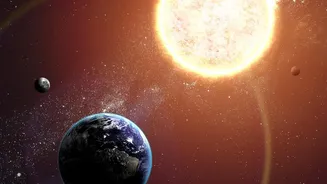
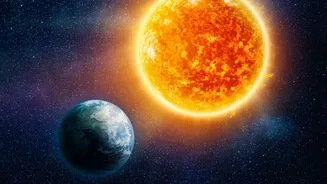
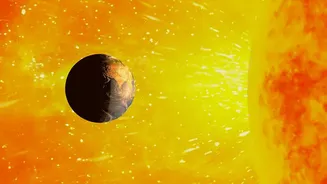
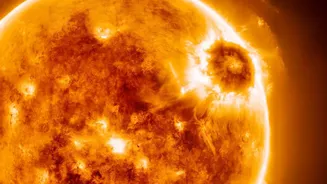
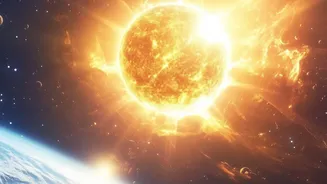
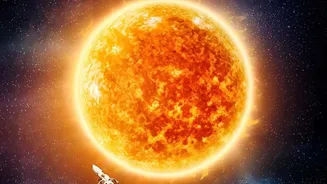
In about five billion years, the Sun will exhaust the hydrogen fuel in its core. Gravity will compress its centre, causing the outer layers to swell dramatically. Our star will transform into a red giant, expanding to over 100 times its current size.
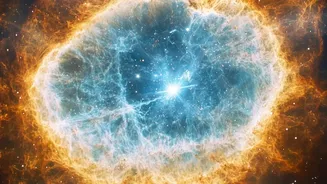
In this phase, it will engulf the inner planets—Mercury and Venus are doomed, and Earth’s fate hangs in the balance, though it will be roasted regardless. After this violent expansion, the Sun will shed its outer layers, leaving behind a dense, hot stellar remnant called a white dwarf, about the size of Earth but holding roughly half the Sun's original mass. For a long time, scientists believed this process would be relatively gentle for the outer planets.
A Cosmic Pinball Machine
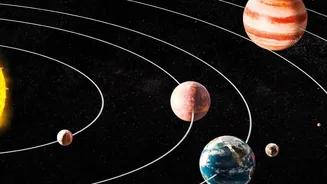
For centuries, the stability of the planets was a foundational question in astronomy, with Isaac Newton himself suspecting the system might be mortal. Modern calculations had suggested the outer planets—Jupiter, Saturn, Uranus, and Neptune—could remain in stable orbits for as long as 100 billion to even a quintillion years after the Sun becomes a white dwarf. However, a new wave of simulations paints a much more violent picture. Recent studies from astrophysicists at Caltech and the University of Michigan challenge the old assumption that the Sun will lose mass smoothly. Instead, they model the process as a series of chaotic, lopsided ejections of material. Each ejection gives the dying Sun a small 'kick', altering its gravitational pull on the remaining planets.
The Giants' Unstable Dance
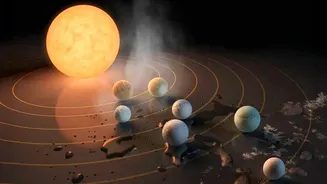
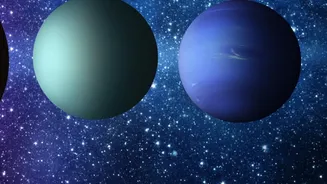
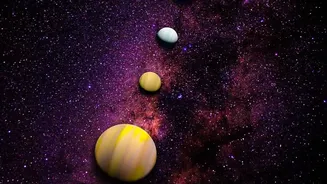
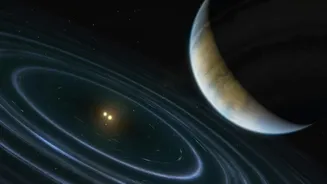
These repeated gravitational nudges from the sputtering Sun will slowly but surely disrupt the delicate balance of the outer solar system. As the Sun loses mass, the orbits of the giant planets will expand. But the chaotic kicks will introduce an element of randomness, pushing and pulling the planets into increasingly unstable paths. The new models show that this gravitational chaos can cause the giant planets to start crossing each other's orbits. In some scenarios, this instability begins even before the Sun fully becomes a white dwarf. The result is a cosmic demolition derby. Planets could be flung out of the solar system entirely, becoming rogue worlds drifting through the galaxy. In other simulated outcomes, Uranus and Neptune might even swap places before the system ultimately falls apart.
A Dramatically Shorter Lifespan
This new understanding of 'terminal instability' drastically shortens the solar system's projected lifespan. Instead of lasting for 100 billion years or more, recent models suggest that in as many as 90% of scenarios, the outer solar system will destroy itself within just a few billion years after the Sun becomes a white dwarf. This is up to 100 times faster than previously estimated. The perpetrator of our solar system's ultimate demise won't be a passing star or slow decay, but the death throes of the Sun itself. As one research team noted, Newton's original suspicion of instability was correct; he was 'mistaken only about the perpetrator'.
Clues from Dead Star Systems
This research isn't just theoretical. Astronomers study existing white dwarf stars to find clues about what our distant future holds. Many white dwarfs have been found to be 'polluted' with heavy elements like silicon, magnesium, and iron. These elements should have sunk into the star's core, so their presence in the atmosphere means the white dwarf is actively consuming the debris of its former planetary system. By observing these distant, dead stars accreting the shattered remains of asteroids and planets, scientists can piece together the story of their violent final chapters. It provides a real-world laboratory for understanding the processes that will one day reshape our own cosmic neighborhood and helps us learn how planetary systems end.