

Decoding Light from Distant Worlds
At the heart of these discoveries is a technique called transmission spectroscopy. Think of it like analysing sunlight after it has passed through a prism, splitting into a rainbow. When an exoplanet passes in front of its host star, the starlight filters
through the planet's atmosphere. Different molecules in that atmosphere, like water vapour, absorb very specific colours, or wavelengths, of light. By looking at the 'missing' colours in the star's light, scientists can identify the chemical fingerprint of the gases present, essentially 'reading' the composition of an atmosphere hundreds of light-years away.
Webb’s Powerful Infrared Eyes
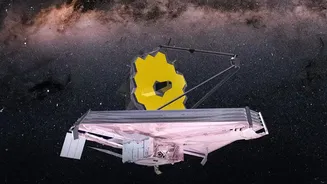
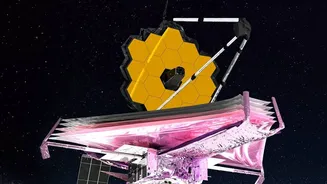
This is where the JWST excels. Its instruments, like the Near-Infrared Spectrograph (NIRSpec), are specifically designed to capture light in the infrared part of the spectrum, which is invisible to the human eye. Many important molecules, including water, methane, and carbon dioxide, leave their most distinct signatures in these infrared wavelengths. Before Webb, detecting these signals from the atmospheres of smaller, rocky planets was incredibly difficult, if not impossible. Now, the telescope's incredible precision and sensitivity allow astronomers to capture these faint signals and begin building a picture of alien climates.
A Universe of Steamy Atmospheres
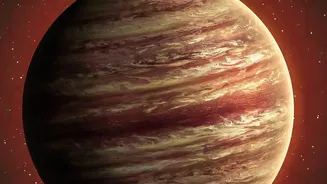
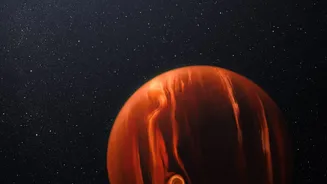
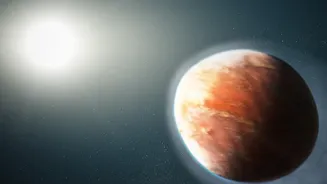
The results have been nothing short of transformative. Webb has detected unambiguous evidence of water vapour in the atmospheres of a wide variety of exoplanets. This includes hot gas giants like WASP-96 b, where the data revealed the presence of not just water, but also clouds and haze. More recently, in early 2026, astronomers reported the clear signature of water on a temperate, rocky exoplanet just 48 light-years away, a world located within its star's habitable zone where liquid water could potentially exist. These findings show that water is a common ingredient in planetary systems across the galaxy.
More Than Just Water
While finding water is exciting, spectrum analysis tells a much richer story. Webb’s observations also detect other critical molecules that provide clues about a planet's potential for life. Scientists have identified carbon dioxide, methane, and even sulphur dioxide in exoplanet atmospheres. The balance of these gases can offer insights into a planet's atmospheric dynamics, its geology, and even hint at biological processes. For example, on the candidate 'Hycean' (hot ocean) world K2-18 b, Webb detected both methane and carbon dioxide, a tantalising combination that scientists are studying closely.
The Search for Habitable Worlds
Ultimately, each detection of water vapour is a monumental step in the quest to find a truly habitable world. By identifying planets with water in their atmospheres, especially those within the 'habitable zone' of their star, astronomers can build a priority list for even more detailed follow-up observations. It’s important to note that the presence of water vapour alone does not guarantee life. Some detections are ambiguous, and scientists must work carefully to rule out other sources, like water vapour in the star itself. However, these discoveries are crucial for narrowing down the vast cosmic haystack and focusing our search on the most promising candidates for life beyond Earth.