






The Ultimate Inflatable Defence
When a pufferfish senses a threat, it doesn’t just hold its breath and hope for the best. Instead, it initiates a rapid, powerful process of inflation. The fish gulps down huge amounts of water in a matter of seconds—some species can take around 35 gulps in just 14
seconds. This water doesn’t just slosh around; it’s channelled directly into a highly specialised stomach that has evolved for one primary purpose: expansion. Unlike a normal digestive organ, the pufferfish’s stomach is incredibly elastic, with folded walls that can stretch to hold a volume up to 100 times its resting state. Strong muscular rings, or sphincters, at the entrance and exit of the stomach clamp shut, trapping the water and turning the fish into a taut, rigid ball.
A Body Built to Balloon
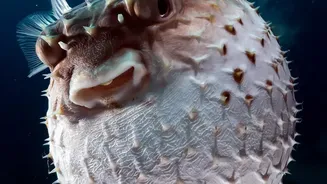
This remarkable transformation is possible because the pufferfish’s entire anatomy is adapted for it. To accommodate the massively expanding stomach, these fish have done away with a rigid rib cage and pelvis. Their spine is also exceptionally flexible, allowing it to curve around the ballooning organ without risk of injury. The skin itself is another marvel. At rest, it appears loose and wrinkly, but it contains collagen fibres arranged in a way that allows it to stretch easily at first and then become firm as the fish reaches full inflation. This turns the pufferfish from a soft, easy-to-bite meal into a hard, nearly spherical object that is incredibly difficult for a predator to get its jaws around. For many species, like the porcupinefish, this expansion also causes sharp spines embedded in the skin to stand erect, adding another painful deterrent.
The High Cost of Puffing Up
While effective, inflating is not a casual act for a pufferfish. It is an exhausting, high-energy emergency response. Studies have shown that the process of gulping water and maintaining the inflated state causes the fish’s oxygen consumption to spike to five times its normal resting rate. Although they can continue to breathe through their gills while inflated, the effort is metabolically taxing. After deflating by expelling the water, it can take a pufferfish over five hours for its metabolism to return to normal. This recovery period leaves the fish vulnerable. Repeatedly forcing a pufferfish to inflate can lead to death from exhaustion or heart failure, which is why it should never be provoked for entertainment.
Water vs. Air: A Crucial Distinction
Pufferfish are designed to inflate with water. If taken out of the water, a panicked pufferfish will instinctively gulp air instead. This is extremely dangerous for the fish. Trapped air is much more difficult for their anatomy to expel than water. A pufferfish filled with air can suffer from buoyancy problems, often getting stuck floating helplessly at the surface, which can lead to internal injuries or death. This is why it is critical to keep the fish submerged if it ever needs to be moved. The entire defence mechanism is calibrated for its aquatic environment, using the incompressibility of water to create a firm, defensive ball.
A Multi-Layered Defence System
Inflation is the pufferfish’s most visible defence, but for many species, it’s only part of the story. Many pufferfish also contain tetrodotoxin, a neurotoxin that can be over 1,000 times more potent than cyanide. This poison, often acquired through their diet from bacteria, is concentrated in their organs and provides a lethal backup plan. If a predator is somehow able to bite or swallow an inflated puffer, the toxin ensures it will be the predator's last meal. This combination of a physical, spiky shield and a deadly chemical weapon makes the slow-swimming pufferfish one of the most well-defended animals in the ocean.