
An Icon in Flux
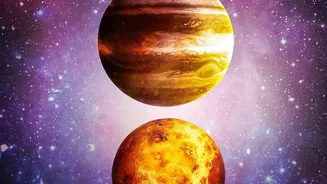
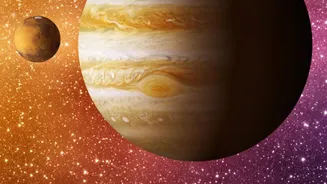
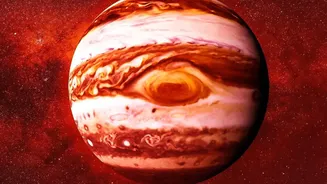
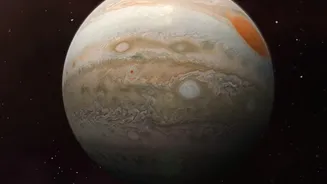
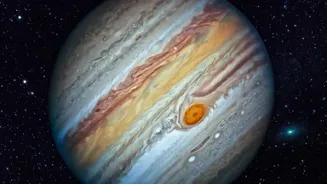
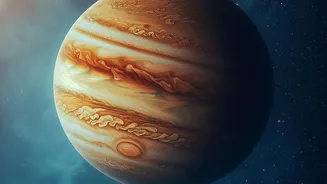
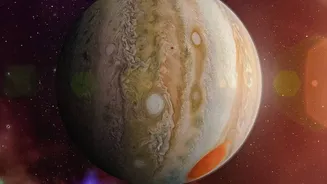
For at least 150 years, and possibly much longer, astronomers have tracked the Great Red Spot, a vast high-pressure system in Jupiter's southern hemisphere. Historically, this anticyclone was an elongated oval large enough to swallow Earth multiple times
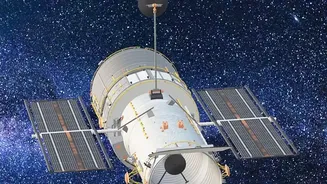
over. However, observations over the past several decades have confirmed a persistent trend: the storm is shrinking. Data from the Hubble Space Telescope and other observatories show the spot has been contracting, losing its oval shape and becoming more circular. In the late 1800s, it was measured to be over 40,000 kilometres wide, but recent captures show it is now less than 14,000 kilometres across. This steady downsizing has led scientists to question the storm's long-term stability and future.
Peering Inside the Storm
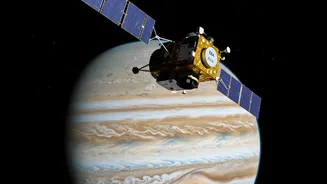
The headline's "cosmic tornados" refer to smaller vortices and eddies that have been observed interacting with the main storm. Using powerful instruments like the James Webb Space Telescope (JWST), scientists are getting an unprecedented look at the complex dynamics inside and around the Great Red Spot. Some researchers hypothesised that these smaller eddies might be 'feeding' the storm, potentially contributing to its accelerated changes by altering its internal energy. New infrared images from JWST's MIRI instrument have revealed patchiness and temperature variations inside the storm that were previously unseen, suggesting differences in cloud thickness and composition. These new captures are allowing scientists to map the storm in three dimensions, from its churning cloud decks to the hazy atmosphere above, providing a more complete picture of its structure.
More Than Just Shrinking
While the shrinking is a major focus, recent observations have revealed even more bizarre behaviour. A dedicated observation campaign by the Hubble Space Telescope showed the storm is not just getting smaller, but is also oscillating in size and speed. Scientists described this unexpected jiggling motion as being like a bowl of gelatin, with the storm expanding and compressing in a rhythmic cycle. During these oscillations, the storm's core also appears to grow brighter. At the same time, studies of the storm's wind speeds have found that while winds near the center have slowed, the winds in its outermost ring have actually sped up. These complex and sometimes contradictory behaviours have left researchers scrambling for explanations, admitting that none of their current models had predicted this.
What Does This Mean for the Spot's Future?
The ultimate fate of the Great Red Spot remains one of the biggest mysteries in planetary science. Will it continue to shrink and eventually disappear? Some research has suggested it could vanish within a few decades. Or will it reach a new, smaller, more stable size and persist for centuries to come? The new data on its internal structure and strange oscillations adds more variables to the equation. Scientists are currently working to understand if the smaller vortices are sapping the storm's energy or helping to sustain it. Because we cannot see deep into the storm's roots, predicting its demise is impossible. What is clear is that this giant storm, once seen as a relatively permanent fixture, is a dynamic and evolving weather system.