




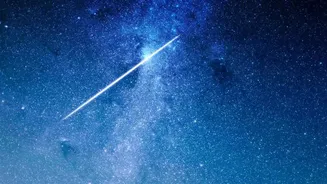

A Gift from Halley's Comet
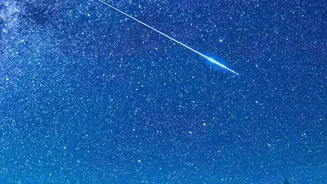
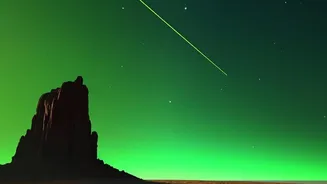
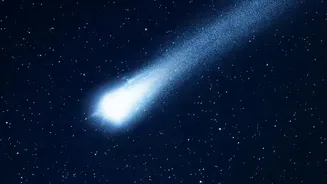
The Orionid meteor shower is one of the most beautiful of the year, known for its fast, bright meteors that can leave glowing trails across the sky. These shooting stars are not stars at all, but tiny pieces of space debris left behind by one of the most famous
celestial visitors: Halley's Comet. As Earth crosses the comet's orbital path each October, these particles burn up in our atmosphere at speeds of around 66 km/s, creating fiery streaks. The shower gets its name because the meteors appear to radiate from a point in the constellation Orion. While the parent comet, Halley, only visits the inner solar system every 76 years—last seen in 1986 and not due back until 2061—its dusty legacy provides this reliable annual show.
The Challenge: A Bright Moon
For 2026, the peak of the Orionids on the night of October 21-22 coincides with a bright waxing gibbous moon. At around 80% illumination, the Moon's glare will be a significant factor, making it much harder to spot the fainter meteors. Under perfect dark sky conditions, the Orionids can produce about 20 meteors per hour. With the moonlight, however, that number will be noticeably reduced. But the situation isn't hopeless. The Moon will set a few hours before sunrise, opening a crucial window of true darkness for dedicated observers.
Tip 1: Time Your Viewing Perfectly
Patience and timing are your best assets this year. The ideal time to watch will be in the pre-dawn hours, specifically after the moon sets. On the peak mornings of October 21 and 22, the moon will dip below the horizon around 3 a.m. local time. This leaves a window of about two hours before the dawn twilight begins to brighten the sky. This period, from roughly 3 a.m. to 5 a.m., will be your prime opportunity to see the Orionids against a dark backdrop, free from lunar interference. While you might see some meteors earlier in the night, the rates will be significantly lower due to the moonlight.
Tip 2: Escape the City Lights
Even with a perfect viewing window after moonset, you won't see much from a light-polluted city or suburb. Finding a location with a dark sky is the single most important step you can take. Drive away from city centres to a spot with a wide, unobstructed view of the sky. Parks, rural areas, or designated dark-sky spots are ideal. The darker your surroundings, the more your eyes will be able to detect the faint streaks of the meteors. Remember that even distant city glow on the horizon can impact visibility.
Tip 3: Block the Glare and Let Your Eyes Adjust
If you are watching before the moon has set, do what you can to mitigate its glare. Position yourself in the shadow of a building, a hill, or a dense line of trees to physically block the Moon from your direct line of sight. This simple trick can make a surprising difference. Regardless of when you watch, give your eyes at least 20-30 minutes to fully adapt to the darkness. Avoid looking at your phone, as the bright screen will ruin your night vision instantly. If you need a light, use a torch covered with red cellophane, as red light is less disruptive to your eyes' dark adaptation.
Tip 4: Get Comfortable for the Wait
Meteor watching is a game of patience, so comfort is key. You don't need a telescope or binoculars; your naked eyes are the best tool because they offer the widest field of view. Lie back on a blanket or a reclining chair to avoid neck strain. October nights can be chilly, so dress in warm layers and consider bringing a sleeping bag or an extra blanket. A thermos with a hot beverage is also a great companion for a pre-dawn sky-watching session. Then, just look up and enjoy the show. The meteors can appear anywhere in the sky, so just relax and scan the darkness.