





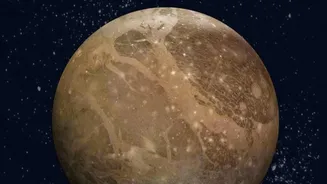

The solar system just got a little more interesting. Astronomers have spotted a new, distant object named 2026 ED138 that is big enough to be a candidate for a very exclusive club: the dwarf planets. Here's what that means.
Meet 2026 ED138
Discovered using data from the
Vera C. Rubin Observatory in Chile, 2026 ED138 is a trans-Neptunian object, or TNO. That's the official term for any minor planet or celestial body that orbits the sun from a greater average distance than Neptune. Currently, it's about 46 times farther from the sun than Earth is. These icy, rocky bodies are considered remnants from the early formation of our solar system, holding valuable clues about its history. Based on its brightness and distance, scientists estimate its diameter is somewhere between 600 and 1,500 kilometers. This size is significant because it puts 2026 ED138 in the running to be classified as a dwarf planet.
The Dwarf Planet Checklist
So, what makes a dwarf planet? According to the International Astronomical Union (IAU), which sets these definitions, an object must meet four criteria. First, it must orbit the Sun. Second, it can't be a moon (or satellite) of another planet. Third, it has not 'cleared the neighborhood' around its orbit, meaning it hasn't become the gravitationally dominant object in its path. This is the key rule that separates dwarf planets from the eight major planets. The fourth and most crucial criterion for 2026 ED138 is that it must have enough mass for its own gravity to pull it into a nearly round shape. This state is known as hydrostatic equilibrium.
Why Size Is the Key Indicator
The reason the size of 2026 ED138 is so exciting is that for icy bodies in the outer solar system, being over a certain diameter makes it very likely they have achieved hydrostatic equilibrium. Gravity pulls matter inward from all directions, and if an object has enough mass, this force will overcome the object's material strength and mold it into a sphere. Smaller objects, like many asteroids and comets, don't have enough gravity to do this, which is why they often have irregular, lumpy shapes. With an estimated size potentially larger than the recognized dwarf planet Ceres, 2026 ED138 is a very strong candidate. Icy bodies of its estimated size are expected to be round.
What Happens Next?
The 'further tests' mentioned in the headline involve more detailed observations. While initial data from the Rubin Observatory and archival images are promising, scientists now need to confirm the object's properties. This will likely involve using powerful instruments, possibly including the James Webb Space Telescope, to study it in the infrared spectrum. These observations can help nail down its exact size, density, and surface composition. By studying how the object reflects light as it rotates, astronomers can also build a 3D model of its shape and confirm whether it is indeed in hydrostatic equilibrium. The process could take time, but the evidence gathered will determine its official classification.
A Growing Solar System Family
If confirmed, 2026 ED138 would join the five official dwarf planets recognized by the IAU: Pluto, Eris, Haumea, Makemake, and Ceres. However, many astronomers believe there are hundreds of other dwarf planet candidates waiting to be discovered and confirmed in the Kuiper Belt and beyond. Discoveries like this one highlight how much we are still learning about our own cosmic backyard. The outer solar system is a vast, populated region, not an empty void. Each new object provides another piece of the puzzle, helping scientists refine their models of how our solar system formed and evolved over billions of years.