

Why Core Stability Matters
Before diving into the exercises, it’s important to understand what your core is and why its stability is crucial. Your core isn't just your six-pack muscles; it's a complex group of muscles including your abdominals, back muscles, and those around the pelvis.
These muscles work together to stabilize your trunk while your arms and legs move. A strong core improves posture, enhances balance, and reduces the risk of injury, especially lower back pain. Everyday activities like carrying groceries, bending down to tie your shoes, or even sitting at a desk become easier and safer with a stable core.
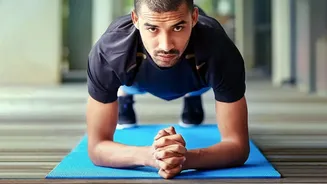
1. The Plank
The plank is a classic isometric exercise, meaning you hold a static position. It engages multiple muscle groups at once, making it incredibly efficient for building foundational strength. It targets not only your abs but also your back, shoulders, and glutes. How to do it: Lie face down and prop yourself up on your forearms and toes, keeping your body in a straight line from your head to your heels. Engage your abdominal muscles by drawing your belly button toward your spine. Avoid letting your hips sag or rise too high. Aim to hold this position for 30 to 60 seconds, focusing on deep, steady breathing. For a modification, you can perform the plank on your knees.
2. The Glute Bridge
Often overlooked as a core exercise, the glute bridge is fantastic for activating your glutes and lower back while also engaging your deep abdominal muscles. This helps create stability from the posterior side of your body, which is essential for good posture and preventing back pain. How to do it: Lie on your back with your knees bent, feet flat on the floor about hip-width apart, and your arms by your sides. Engage your core and squeeze your glutes as you lift your hips off the floor. Your body should form a straight line from your shoulders to your knees. Hold for a few seconds at the top, squeezing your glutes tightly, then slowly lower your hips back down with control.
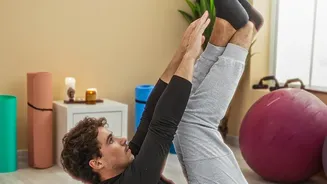
3. The Dead Bug
The Dead Bug is an excellent exercise for improving core stability and coordination without putting stress on your back. It trains your core to resist extension and rotation, which is key for protecting your spine during movement. How to do it: Lie on your back with your arms extended toward the ceiling and your legs in a tabletop position (knees bent at 90 degrees over your hips). Keeping your core engaged and your lower back pressed gently into the floor, slowly lower your right arm and left leg toward the ground simultaneously. Go as low as you can without your back arching. Return to the starting position with control and repeat on the other side. The movement should be slow and deliberate.
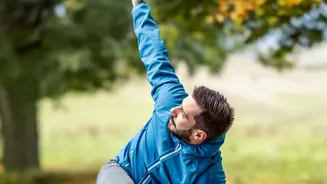
4. The Bird-Dog
Similar to the Dead Bug, the Bird-Dog exercise challenges your stability by moving opposite limbs, but from an all-fours position. It's brilliant for enhancing balance, posture, and strengthening the muscles that run along your spine. How to do it: Start on your hands and knees, with your hands directly under your shoulders and your knees under your hips. Keep your back flat and your core engaged. Extend your right arm straight forward and your left leg straight back, keeping both parallel to the floor. Hold for a moment, ensuring your hips and shoulders don't rotate. Return to the starting position and repeat with your left arm and right leg. Focus on control rather than speed.
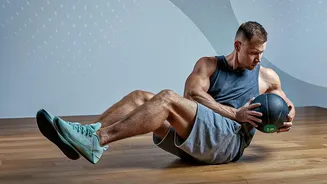
5. Bicycle Crunches
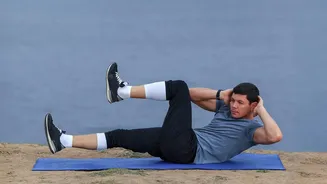
While traditional crunches can sometimes strain the neck, the bicycle crunch variation works the entire abdominal wall, including the obliques on your sides, in a more dynamic way. It’s a great way to build rotational strength and muscular endurance. How to do it: Lie on your back with your hands lightly behind your head and your knees bent. Lift your head, shoulders, and feet off the floor. Bring your right knee toward your chest while simultaneously twisting your torso to bring your left elbow toward your right knee. Straighten your right leg as you bring your left knee in and your right elbow toward it. Continue alternating sides in a fluid, pedaling motion. Remember to lead with your shoulder, not just your elbow, to properly engage your obliques.