


Cosmic Monsters in the Dark
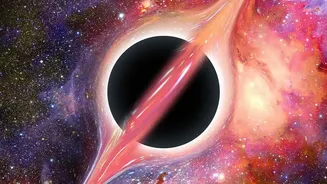
At the heart of most large galaxies, including our own Milky Way, lurks a supermassive black hole—an object with millions or even billions of times the mass of our sun, packed into an incredibly dense point. By definition, black holes emit no light, making
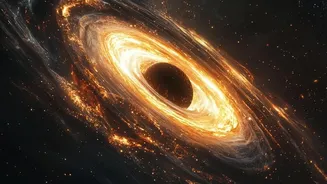
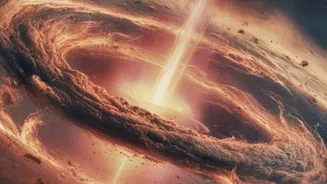
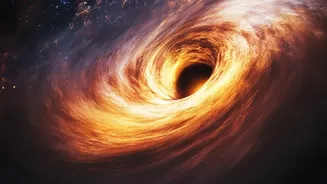
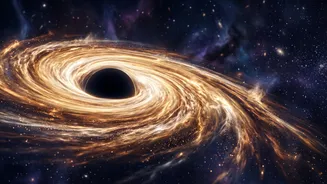
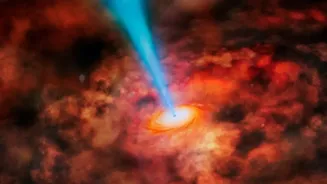
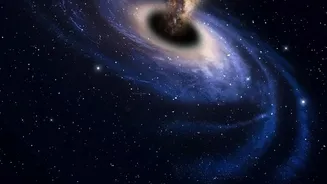
them impossible to see directly. So how do you study something that is invisible? Astronomers look for the evidence of its existence: the dramatic effects of its immense gravity on its surroundings. Specifically, they focus on the accretion disk—a swirling, superheated platter of gas, dust, and shredded stars that are spiralling towards the point of no return. This material gets so hot from friction that it glows intensely across the electromagnetic spectrum, from radio waves to powerful X-rays, creating some of the brightest objects in the universe known as quasars. This light from the accretion disk is the key to understanding the monster it feeds.
A Ten-Year Watch
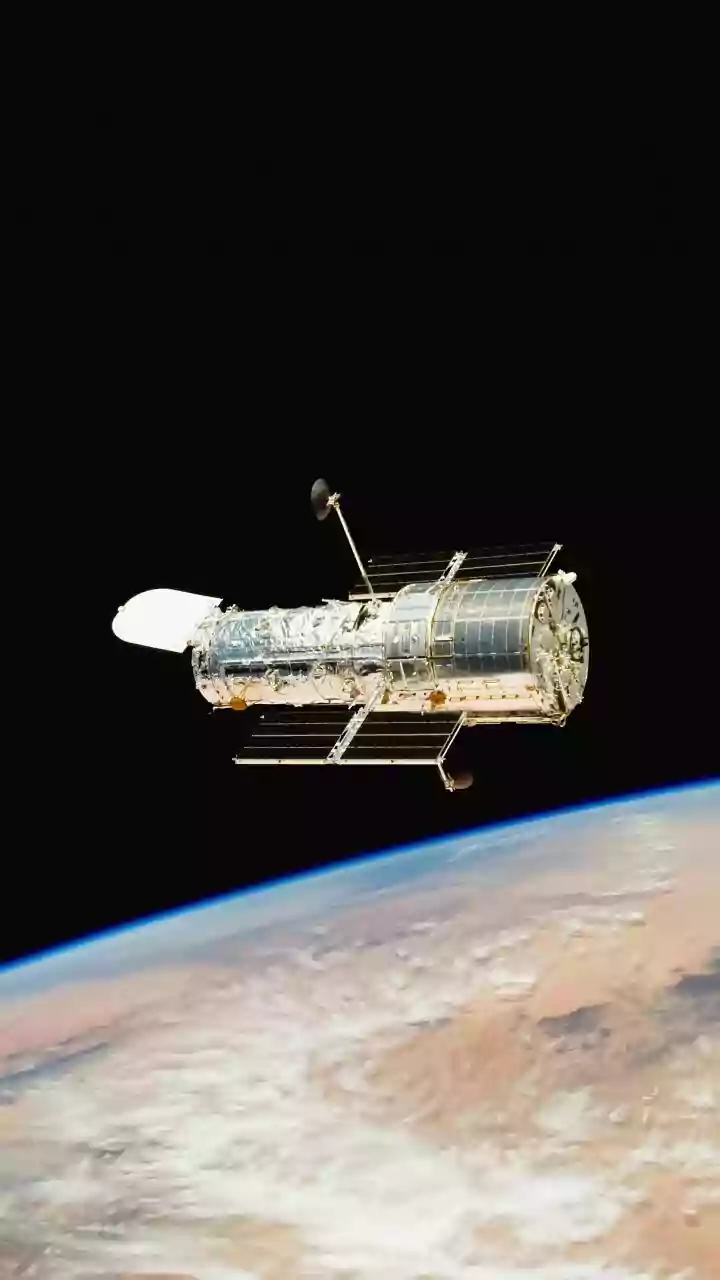
To understand how a black hole grows, you have to watch it eat. That’s precisely what a team of astronomers set out to do in a remarkable long-term study. For over a decade, they pointed multiple telescopes at the centre of a distant galaxy, patiently collecting data. This wasn't a casual glance; it was a sustained vigil designed to capture the dynamic processes happening around the black hole over time. Such long-duration projects are rare in astronomy but are essential for understanding processes that unfold over years. The goal was to move beyond a simple snapshot and create a long-term film of the black hole's accretion process. The technique they used, known as 'reverberation mapping' or 'echo mapping', relies on catching the faint echoes of light from the heart of the accretion disk.
What is Spectral Data?
The crucial information gathered over this decade came in the form of spectral data. Essentially, spectroscopy is the science of breaking light down into its constituent colours, much like a prism creates a rainbow. Every chemical element, when heated, emits or absorbs light at very specific wavelengths, creating a unique 'fingerprint' or barcode. By analysing these spectral lines from the accretion disk, astronomers can determine its chemical composition, temperature, density, and how fast the material is moving. Over the ten-year period, the scientists watched how these spectral fingerprints changed. Flares of light from deep within the accretion disk would travel outwards, illuminating gas clouds further away and causing them to light up in response—an 'echo'. By measuring the tiny time delay between the initial flare and its echo, they could map the structure and behaviour of the material swirling into the black hole.
The Messy Eater
The decade of data revealed a groundbreaking insight: supermassive black holes are not neat, steady eaters. Their mass accumulation is a chaotic, clumpy, and highly variable process. For a long time, models had often assumed a smooth, constant flow of gas. This research shows the reality is far more complex. The study observed significant changes in the powerful winds blowing off the accretion disk. Sometimes these winds were strong enough to block the light from the centre, while at other times they would virtually disappear. This suggests that a black hole's growth happens in fits and starts. It might gorge on a large clump of gas or a tidally disrupted star, causing a flurry of activity, and then settle into a quieter period. This 'messy eating' changes how we picture the immediate environment around these cosmic giants.
Connecting Dots Across the Universe
This discovery isn't just about one black hole; it has profound implications for how we understand the evolution of entire galaxies. The way a black hole grows is directly linked to the growth of its host galaxy. The immense energy and radiation blasting out from an active black hole's accretion disk—a process called 'feedback'—can regulate or even shut down star formation across the galaxy. By providing a more accurate, real-world model of how black holes accumulate mass, this decade-long study gives cosmologists crucial data to refine their simulations of galaxy formation. It helps answer why black holes in the early universe appeared to grow so quickly and why their growth seems to have slowed down over cosmic time. The finding confirms that the relationship between a galaxy and its central black hole is a dynamic and complex dance that has shaped the cosmos we see today.