




A Monumental Deep-Sea Event
For the first time in history, scientists have captured a complete seafloor spreading event as it happened. In April 2024, deep in the southern Indian Ocean, a section of the Earth's crust tore apart along the Southeast Indian Ridge. This tectonic boundary
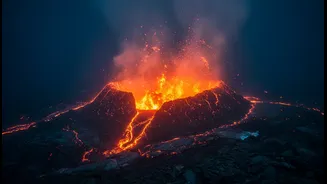
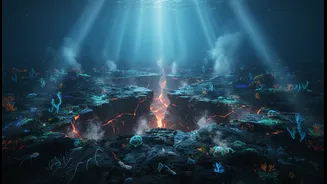
is where two oceanic plates are slowly moving away from each other. Over 16 days, an immense volume of molten rock—estimated at up to 160 million cubic metres—poured out onto the seabed, constructing a fresh layer of oceanic crust. The event began with a swarm of earthquakes that migrated along the ridge, signalling that magma was forcing its way upwards through fractures in the crust.
Visualising the Scale
It can be difficult to comprehend the sheer volume of 160 million cubic metres of lava. To put it in perspective, this is enough molten rock to fill approximately 64,000 Olympic-sized swimming pools. The new lava flows created deposits that were, in some places, over 90 metres thick and stretched for several kilometres across the ocean floor. The eruption was so significant that instruments on the seabed detected the valley floor sinking by roughly four metres as the magma chamber below emptied itself. This entire episode accomplished in about two weeks what would normally take decades of slow-and-steady plate movement.
Science on the Seafloor
The breakthrough observation was made possible by an array of instruments deployed just two months before the eruption by the French-led OHA-GEODAMS project. This network, which included acoustic monitors, geodetic beacons, and pressure sensors, was perfectly positioned to record the drama. As the lava, with temperatures exceeding 1,000 degrees Celsius, met the near-freezing seawater, it triggered violent reactions. Hydrophones recorded thousands of acoustic signals as the water boiled, creating huge plumes of mineral-rich fluid. The lava cooled rapidly into bulbous shapes known as 'pillow basalt', which now form the newest piece of Earth's surface.
A New Frontier for Life
An event of this magnitude does more than just reshape the underwater landscape; it creates an entirely new environment. The sterile, fresh rock provides a blank slate for life. The intense heat and chemical reactions also create hydrothermal vents. These deep-sea geysers spew out hot, mineral-rich water that can support unique ecosystems, completely independent of sunlight. These environments are home to extremophiles—organisms that thrive in conditions that would be deadly to most other life forms. Scientists are eager to study how life colonises this new territory, offering insights into how life may have begun on our planet.
Why This Discovery Matters
Witnessing seafloor spreading in real time is a landmark achievement for geology. It confirms long-held theories about how two-thirds of our planet's crust was formed at these mid-ocean ridges. Beyond the fundamental science, this research has practical implications. The deep ocean floor hosts a vast network of underwater fibre-optic cables that are the backbone of global communication and finance. Understanding where the seafloor is actively splitting and erupting helps in planning safer routes for this critical infrastructure. This rare glimpse into Earth's engine room reminds us that even the most seemingly stable parts of our world are in a constant state of flux, driven by powerful forces deep beneath the surface.