



What Is This New Classroom?
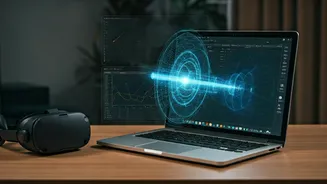
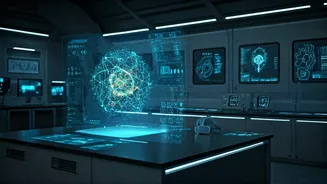
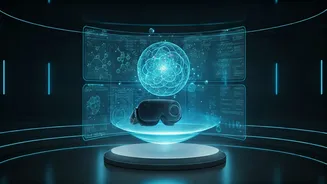
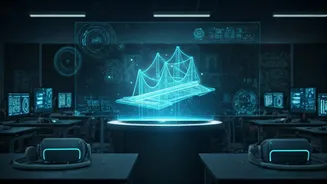
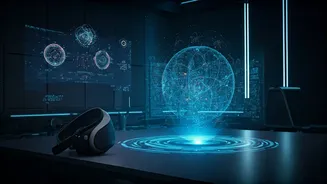
At its heart, a VR classroom is a fully immersive, 3D digital environment. Students put on a VR headset and are transported to a virtual laboratory or even the surface of a distant planet. Unlike a video or a simple animation, they can interact with this
world. They can pick up virtual objects, conduct experiments, and see complex concepts unfold before their eyes. The integration of AI takes this a step further. It isn't just a pre-programmed simulation; it's a dynamic and responsive learning space. This technology combines the visual immersion of VR with the intelligence of an AI tutor, creating a powerful tool for subjects that are difficult to visualize, like advanced physics.
The Magic of Predictive AI
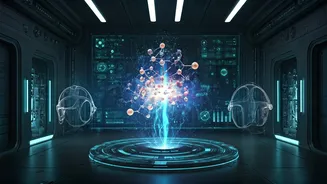
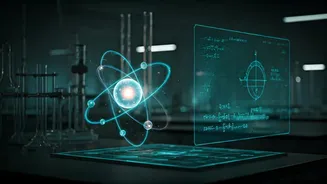
The term 'predictive AI' might sound like it’s telling the future, but its role here is far more practical and powerful. In this context, the AI performs two key functions. First, it runs incredibly complex simulations that would be impossible in a real-world school lab. It can accurately model the behaviour of subatomic particles, the warping of spacetime around a black hole, or the flow of electromagnetism. Students can change variables—like mass, speed, or charge—and the AI instantly predicts and simulates the realistic outcome. Second, the AI studies the student's behaviour. It can predict where a student might struggle, identify common misconceptions based on their actions within the simulation, and offer personalized hints or alternative explanations. It’s like having a dedicated expert tutor for every student, guiding them through the trickiest parts of the curriculum.
Why This Is a Game-Changer
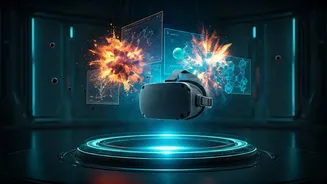
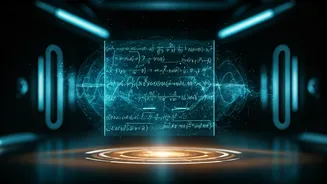
Traditional physics education often hits a wall. Concepts like string theory or special relativity are abstract and mathematical, making them hard for many students to grasp intuitively. Furthermore, physical laboratories are expensive to build, stock, and maintain, and they can’t be used for experiments that are too dangerous, too small, or too large-scale. VR classrooms solve these problems. They make the invisible visible, allowing students to develop an intuitive understanding of complex phenomena. They provide a safe space to experiment without risk or material cost—you can 'spill' virtual acid or cause a 'meltdown' with zero real-world consequences, learning valuable lessons in the process. This democratises access to high-quality science education, giving any school with the headsets the power of a world-class laboratory.
The Opportunity for India
For a country like India, with a strong focus on STEM education and a vast, diverse student population, this technology is particularly promising. The National Education Policy (NEP) 2020 emphasizes experiential and discovery-based learning, a principle that VR simulations embody perfectly. This technology could help bridge the significant gap in resources between urban and rural schools. Instead of needing to fund thousands of high-spec physics labs, the government and private institutions could invest in scalable digital infrastructure. It offers a path to providing students in remote areas with the same quality of conceptual learning as those in metropolitan centres, levelling the playing field for competitive exams and future scientific careers.
Real-World Hurdles Remain
Despite the immense potential, widespread adoption isn't just around the corner. The primary barriers are cost and infrastructure. High-quality VR headsets are still expensive for mass deployment in schools. Reliable, high-speed internet is a must for seamless experiences, which remains a challenge in many parts of the country. Beyond the hardware, there is the crucial human element. Teachers need to be trained not just on how to use the technology, but on how to integrate it effectively into their pedagogy. Curriculums must be adapted to leverage these new tools, moving beyond rote memorisation to foster genuine inquiry and critical thinking. These are not small challenges, but they are solvable with focused investment and strategic planning.