




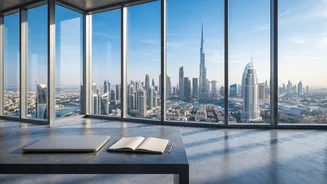

Strategic Gateway to Global Markets
Dubai’s geographical position is its silent superpower. Situated at the crossroads of Europe, Asia, and Africa, it offers Indian businesses unparalleled access to a consumer base of over 2.5 billion people within a short flight. This isn't just about
logistics; it's about market proximity. For a startup that has perfected its product-market fit in India, Dubai serves as a springboard into the broader Middle East and North Africa (MENA) region, a market that can be challenging to enter directly. The city’s world-class airports and seaports, like Jebel Ali Port, create a seamless corridor for trade and export, reducing friction for businesses scaling their physical or digital operations. The strong, long-standing trade relationship between India and the UAE further solidifies this advantage, making it a natural, friendly territory for expansion.
Favourable Tax and Business Environment
Dubai's tax regime is a significant draw, but it requires a nuanced understanding. While there is a 0% personal income tax, the UAE has introduced a federal corporate tax. However, it's structured to be highly competitive, with a 0% rate for taxable profits up to AED 375,000 to support startups and small businesses. Above that, a 9% rate applies. The real advantage often lies within the numerous free zones, which are special economic areas designed to attract foreign investment. Companies that qualify as a 'Qualifying Free Zone Person' can still benefit from a 0% corporate tax on their 'qualifying income', provided they meet specific criteria, such as not conducting most of their business with mainland UAE. Furthermore, most business activities now allow for 100% foreign ownership, eliminating the historical need for a local sponsor and giving Indian entrepreneurs full control of their ventures.
Access to a Deep Pool of Capital
An idea is only as good as the funding it can attract, and Dubai is actively working to bridge the capital gap. The government has shown serious commitment through initiatives like the AED 1 billion Dubai Future District Fund (DFDF), an evergreen venture fund designed to back high-growth startups and VC funds. This fund specifically views the India-UAE relationship as a natural partnership and seeks to attract Indian founders. Beyond government-led efforts, Dubai has a rapidly maturing ecosystem of private venture capital firms, angel investors, and financial institutions. Hubs like the Dubai International Financial Centre (DIFC) have become magnets for both startups and investors, creating a dense network where founders can connect with capital. Accelerator programs within DIFC and other innovation hubs provide further opportunities for funding and mentorship.
A Welcoming Visa and Regulatory Framework
Recognizing that talent is mobile, the UAE has streamlined its residency rules for entrepreneurs. The Golden Visa program is a game-changer, offering long-term residency (5 or 10 years) to investors, entrepreneurs, and skilled professionals without the need for a local sponsor. This provides stability for founders and their families, allowing them to live, work, and study with ease. Beyond visas, the process of setting up a business has become remarkably efficient, especially within free zones like the Dubai Multi Commodities Centre (DMCC), which is home to thousands of companies and offers a simplified setup process. The government’s business-friendly stance is clear in its efforts to cut red tape and create a predictable, transparent legal framework based on English common law in financial free zones like DIFC.
A Hub for Innovation and Talent
Dubai is not just importing businesses; it is cultivating an entire ecosystem of innovation. There is a concerted push to become a global leader in future-focused sectors like AI, FinTech, and deeptech. Initiatives like the Dubai AI Campus and collaborations with NASSCOM to create an 'AI corridor' between Dubai and Bengaluru highlight a strategic effort to attract India's top tech talent. For startups, this means access to a diverse, international talent pool and being part of a community that is actively supported by the government. Innovation hubs within free zones like DIFC and DMCC host accelerators, incubators, and networking events, fostering collaboration between startups, corporate partners, and investors, and creating a fertile ground for new ideas to flourish.