





The Fact That Breaks Your Brain
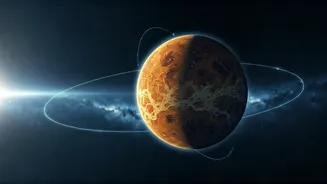
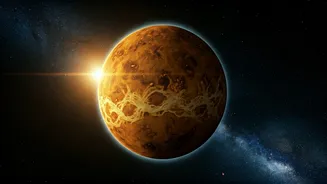
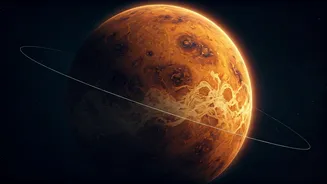
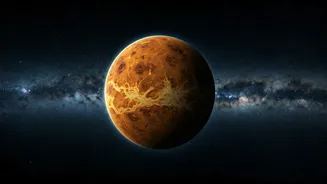
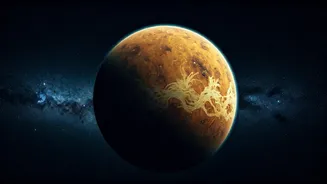
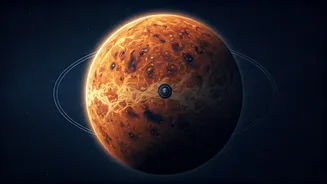
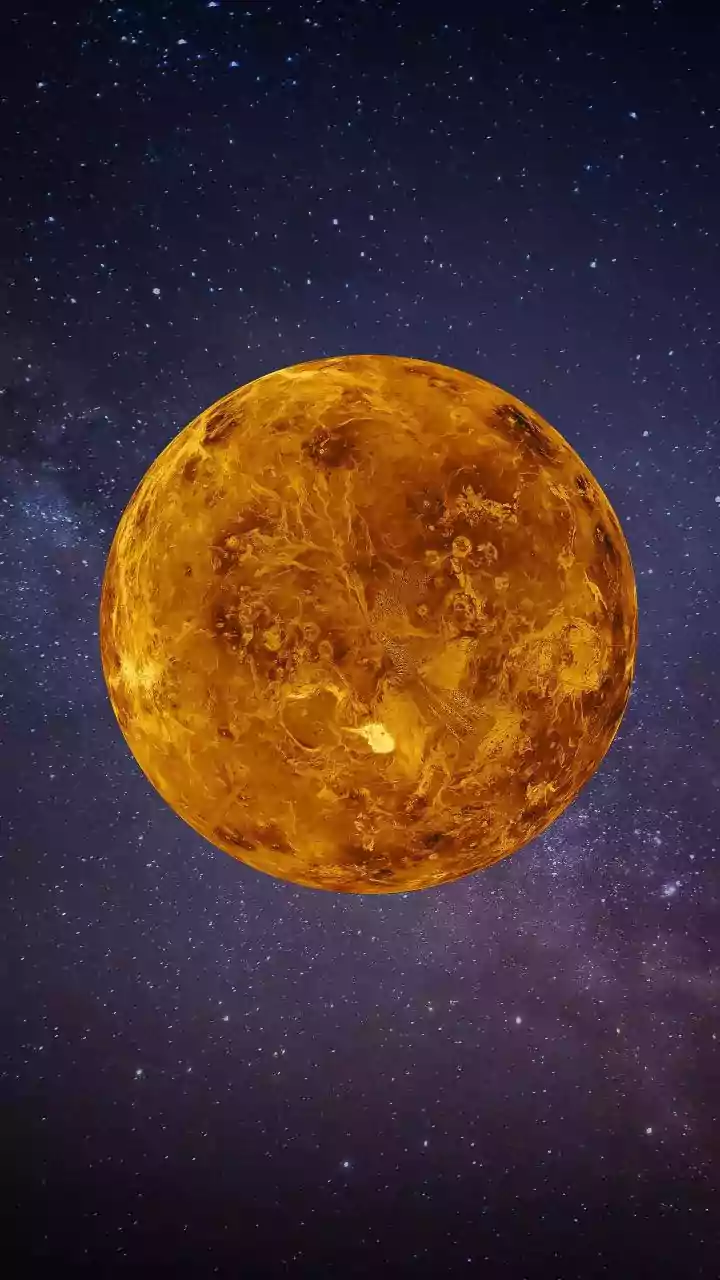
Let’s get straight to it. The single fact causing a stir is this: a day on Venus is longer than a year on Venus. It sounds impossible, like a line from a sci-fi novel, but it’s a fundamental truth of our planetary neighbour. To be precise, it takes Venus about
225 Earth days to complete one orbit around the Sun (a Venusian year). However, it takes the planet a staggering 243 Earth days to complete one rotation on its axis (a Venusian day). This means that if you could somehow stand on the surface of Venus, you would experience an entire year pass by before you experienced a full day-night cycle. It’s a concept so alien that it forces us to reconsider the very nature of what a “day” can mean on another world.
How Is This Even Possible?
This temporal anomaly is the result of two key factors: Venus’s incredibly slow spin and its retrograde rotation. Unlike Earth and most other planets in our solar system, Venus spins backwards. If you were on Venus, the Sun would appear to rise in the west and set in the east. This retrograde motion is thought to be the result of a massive collision early in its history that literally knocked the planet off-kilter, or perhaps the result of a thick, heavy atmosphere dragging on the surface over billions of years, slowing and eventually reversing its original spin. The slowness of this spin is the real star of the show. While Earth zips around on its axis once every 24 hours, Venus ambles along, taking 243 of our days to do the same. Its leisurely rotation period is just slightly longer than its relatively quick orbit around the sun, creating this mind-bending day-year relationship.
A Day That Lasts Forever (and Melts Lead)
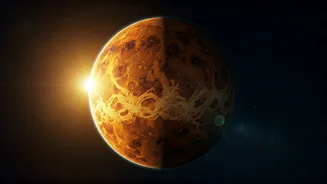
This incredibly long day has catastrophic consequences for the planet’s environment. Imagine a day where the sun stays in the sky for months at a time, baking one side of the planet relentlessly. This prolonged, intense solar heating contributes to Venus’s runaway greenhouse effect. Its atmosphere is over 96% carbon dioxide, and the surface pressure is 92 times that of Earth’s. This combination traps heat so effectively that surface temperatures average a scorching 465° Celsius—hot enough to melt lead. The long night that follows offers little relief, as the thick blanket of an atmosphere holds onto the heat. This extreme temperature is uniform across the planet; there are no cooler poles or temperate zones on Venus. It is, from pole to pole and from day to night, a planetary furnace.
The Atmosphere on Overdrive
Here's where it gets even stranger. While the planet itself rotates at a walking pace, its upper atmosphere is a completely different story. The clouds on Venus, made of sulfuric acid, whip around the planet at speeds up to 360 kilometres per hour—a phenomenon known as “super-rotation.” These winds circle the entire planet in just four to five Earth days, a speed that is 60 times faster than the planet’s own rotation. Scientists are still working to understand the precise mechanics behind this super-rotation. It’s a massive atmospheric mystery directly linked to the planet's slow spin. The extreme difference in speed between the solid planet and its gaseous shell creates a dynamic, violent weather system unlike anything seen elsewhere in the solar system.
What New Science Tells Us
For years, these figures were good estimates. But recent research has pinned them down with incredible accuracy. A 2021 study, conducted over 15 years by beaming radar from Earth to Venus, confirmed the precise length of a Venusian day down to the millisecond. The measurements were so exact they revealed the planet's axis is tilted by a mere 2.64 degrees (compared to Earth's 23.5) and that it wobbles in a predictable cycle. More importantly, the data allowed scientists to calculate the size of Venus’s core—roughly 3,500 kilometres in radius—even though they couldn’t see it. Understanding the core is key to understanding the planet’s history, including why it lacks a magnetic field, leaving it exposed to harsh solar winds, and why its rotation is so peculiar.