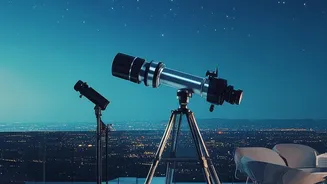








The Challenge of Urban Skies
For millions living in urban centres, the celestial spectacle of a star-filled night is a distant memory, obscured by the persistent glow of light pollution. This widespread artificial brightness from streetlights, buildings, and advertising creates a luminous
blanket, washing out all but the brightest stars and planets from view. This disconnects us from a fundamental part of our environment, a view that has inspired wonder and curiosity for millennia. While escaping to a designated dark-sky site is ideal, it’s not always practical. Fortunately, you no longer need to leave the city behind to connect with the cosmos. A new generation of powerful tools is putting the universe back within our reach, right from a city balcony or local park.
A Planetarium in Your Pocket
The solution lies in the device most of us carry everywhere: our smartphone. Modern stargazing applications use your phone's built-in GPS, compass, and gyroscope to know exactly where you are and which way you're pointing. They then generate an accurate map of the sky, overlaying it on your screen in real time. The most impressive feature for urban astronomers is augmented reality (AR). By accessing your phone's camera, these apps can superimpose the names, paths, and outlines of stars, constellations, and planets directly onto your view of the sky. Even if a star is too faint for your naked eye to see past the city glow, the app can show you exactly where it is, identifying it for you.
Top Apps to Start Your Journey
With numerous options available, here are a few standout apps perfect for urban stargazers: Stellarium Mobile: Widely considered one of the best all-rounders, Stellarium has a massive database of stars, planets, and galaxies. Its free version is incredibly powerful, offering a clean interface to help you identify what you're looking at just by pointing your phone at the sky. The paid 'Plus' version expands the catalogue for more serious users and even allows for telescope control. Star Walk 2: Known for its beautiful design and user-friendly interface, Star Walk 2 is great for beginners. It excels at making astronomy accessible and fun. The app includes an augmented reality view and a 'Time Machine' feature that lets you see the sky at different times, which is perfect for planning when to look for specific planets or events. Sky Tonight: This app is praised for its modern interface and powerful free features. It not only helps you identify objects but also provides a stargazing forecast based on weather, light pollution, and the lunar phase. You can set customizable notifications for events like International Space Station passes or meteor showers, making it a practical tool for planning your sessions.
Tips for City Stargazing Success
An app can guide your eyes, but a few simple tricks can significantly improve your urban stargazing experience. First, seek out the darkest spot you can find, like a large park or a quiet rooftop, away from the direct glare of streetlights. Give your eyes at least 15-20 minutes to adjust to the darkness; this will help you spot fainter objects. While countless stars will remain hidden, the Moon and bright planets like Venus, Mars, Jupiter, and Saturn are easily visible from most cities. Your app can tell you exactly when and where to look for them. Many apps also feature a red-light mode, which helps preserve your night vision while you use it.