

More Than a Random Streak
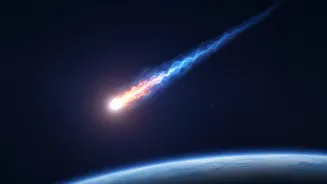
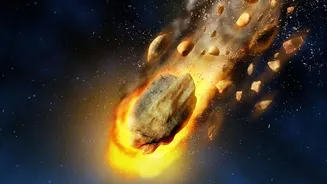
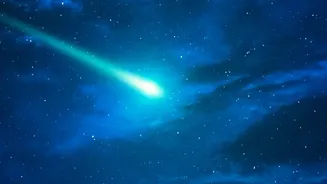
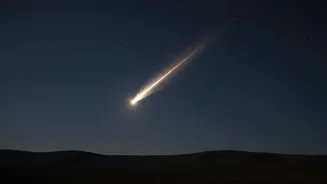
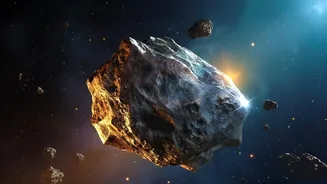
First, let's clarify what we're seeing. A meteor is the visible path of a meteoroid—a small piece of rock or dust from space—as it enters Earth’s atmosphere and burns up. While a lone meteor, known as a sporadic, can appear randomly, many are part of larger
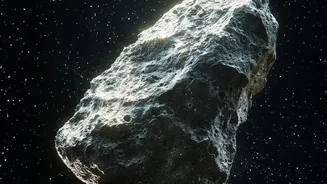
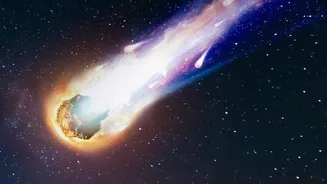
events called meteor showers. These showers occur when Earth passes through a stream of debris left behind by a comet or, occasionally, an asteroid. The key insight is that the particles in these streams are all traveling on roughly parallel paths through space. This shared trajectory is the first major clue that astronomers use to begin their investigation. By tracking the direction of these meteors, scientists can distinguish a member of a predictable shower from a random visitor.
Finding the Radiant Point
If you watch a meteor shower, you'll notice the streaks of light don't just move in the same general direction; they appear to originate from a single point in the sky. This point is called the radiant. It’s an effect of perspective, similar to standing on a long, straight road and seeing the edges seem to converge at a vanishing point on the horizon. The meteors are traveling on parallel tracks, but from our viewpoint on Earth, they appear to fan out from this radiant. This is incredibly useful because it allows astronomers to classify different meteor showers. Showers are typically named after the constellation where their radiant is located, such as the Perseids (radiant in Perseus) or the Geminids (radiant in Gemini).
Tracing Back to a Parent Body
Once astronomers establish a meteor shower's radiant point, they can use its trajectory and velocity to calculate the orbit of the meteoroids. This is the most exciting part. By comparing this calculated orbit with the known orbits of comets and asteroids, they can often find a match. This is how we know, for example, that the Perseid meteor shower originates from debris shed by Comet Swift-Tuttle, and the Geminids come from an asteroid called 3200 Phaethon. Identifying this 'parent body' is a huge win. It tells scientists about the object’s composition—whether it’s a dusty, icy comet or a rocky asteroid—and helps them map the invisible rivers of debris that crisscross our solar system. These meteoroid streams are remnants of our solar system's formation and evolution, offering a direct sample for study.
Identifying Interstellar Visitors
Perhaps the most thrilling reason a meteor's direction matters is its potential to reveal visitors from beyond our solar system. Most objects in our solar system travel at speeds determined by the Sun's gravity. However, an object arriving from another star system would carry the velocity of its home system and would be moving much faster. Its trajectory would be unique and not bound to our sun. By precisely measuring a meteor's path and extreme speed, astronomers can identify it as an interstellar object. In 2014, for instance, a meteor that impacted over Papua New Guinea was later confirmed to be of interstellar origin based on its high velocity and trajectory. These rare events provide an incredible opportunity to study material from other parts of the galaxy without ever leaving our own cosmic neighbourhood.