






A Broadband Moment for Deep Space
Humanity's ambition in space is growing, with plans for crewed missions to Mars and advanced robotic explorers venturing further than ever before. But there has always been a fundamental bottleneck: data transmission. Conventional radio frequency (RF)
systems, the workhorse of space communication for over half a century, are struggling to keep up with the vast amounts of data modern missions can generate. This data traffic jam risks slowing down science and exploration. To solve this, NASA has successfully demonstrated its Deep Space Optical Communications (DSOC) technology, a system designed to transmit data at rates 10 to 100 times faster than the best radio systems used today. This isn't just an incremental improvement; it's a leap that could redefine our relationship with the cosmos.
How Laser Communication Works
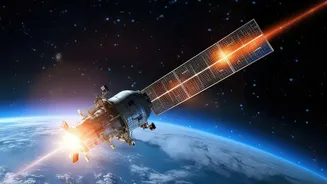
The principle behind optical communication is surprisingly simple: it encodes data onto laser beams. Think of it as the difference between a floodlight and a laser pointer. Radio waves spread out, dispersing energy and limiting data rates over long distances. Lasers, on the other hand, use near-infrared light, which has a much higher frequency. This allows them to pack significantly more data into a tightly focused beam. This narrow beam travels across millions of kilometers, where it is collected by large ground-based telescopes, like the Hale Telescope at Caltech’s Palomar Observatory. This efficient, high-bandwidth approach is what enables the massive increase in data transmission speeds.
Record-Breaking Transmissions
The DSOC experiment, hitching a ride on NASA’s Psyche spacecraft, has already shattered records. In one landmark test, it streamed the first-ever ultra-high-definition video from deep space, sent from a distance of 19 million miles. The video, which humorously featured a cat named Taters chasing a laser, was transmitted at a stunning rate of 267 megabits per second (Mbps)—a speed comparable to terrestrial broadband internet. Even as the Psyche spacecraft traveled farther, to a distance of 140 million miles, the system was able to transmit engineering data at 25 Mbps. These tests prove that the technology is not just theoretical but a viable tool for future missions, capable of maintaining high data rates even at vast interplanetary distances.
The Challenge of Hitting the Target
Transmitting a laser beam across the solar system is an incredible feat of precision. The spacecraft and Earth are both moving at immense speeds, meaning engineers can't just aim at where Earth is, but must calculate where it will be by the time the light arrives. The ground station on Earth first sends a powerful laser beacon toward the spacecraft to serve as a pointing reference. The spacecraft's transceiver then locks onto this beacon and sends its data-carrying downlink laser back with microradian-level accuracy—equivalent to hitting a target the size of a coin from a kilometer away. Overcoming this pointing challenge was a critical milestone, demonstrating the system's reliability for future, more complex missions.
What This Means for Exploring the Cosmos
The implications of this technology are enormous. For scientists, it means receiving vast quantities of data from scientific instruments far more quickly, accelerating the pace of discovery. Instead of waiting weeks to receive a complete map of Mars, it could take just days. For the public, it opens the door to receiving high-definition video and imagery from other worlds, making space exploration more immediate and engaging. Most importantly, this high-bandwidth communication is considered an essential technology for supporting human missions to Mars. Astronauts would be able to communicate with Earth in near-real-time with high-quality video, a critical capability for both mission operations and morale on a multi-year journey.