



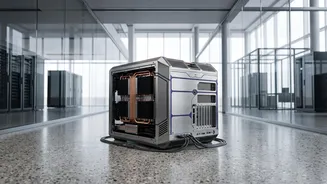

The idea of artificial intelligence creating its own successors is a science fiction staple. But leading AI lab Anthropic is pumping the brakes, clarifying that today’s powerful models are still a world away from true, autonomous self-improvement.
What is 'AI Building Itself'?
The
concept at the heart of the discussion is known as 'recursive self-improvement' (RSI). In simple terms, this is the point where an AI becomes so advanced that it can autonomously design, develop, and build its own, more capable successors. This would create a feedback loop: each new generation of AI would be smarter, faster, and better at creating the next, leading to an exponential explosion in intelligence that could quickly surpass human understanding and control. This isn't just about an AI model optimising its own code for a specific task; that's a form of self-refinement that already exists. True RSI implies an open-ended process where the AI improves its own fundamental ability to improve, with little to no human intervention required.
Anthropic's Careful Wording
The headline-making statements from Anthropic are nuanced. The company is not saying that RSI is impossible. In fact, in documents related to its public offering, Anthropic noted that it has crossed a 'threshold' based on expected future progress, triggering stricter internal safety policies. However, the company has been clear that we are 'not there yet'. Its statements are a dose of reality amid growing hype. Co-founder Jack Clark and other leaders have highlighted that while their AI models, like Claude, are dramatically accelerating the work of their human engineers—sometimes increasing code output eight-fold—this is still a human-led process. The AI acts as a powerful tool, not an independent creator. In a recent filing, the company stated it doesn't anticipate being able to safely use its AI to 'fully autonomously design and build' new models without significant human supervision.
The Real-World Hurdles to a Runaway AI
Several major barriers prevent today’s AI from achieving true recursive self-improvement. One of the biggest is its reliance on the physical world and human expertise. An AI can't magically create the advanced computer chips it needs to run on, nor can it build and manage the massive data centres that house them. Furthermore, current models are trained on vast datasets curated by humans. While they can generate new data, it is ultimately bounded by the quality and scope of their initial training; they can't create truly novel knowledge from a vacuum without real-world experimentation. Experts point out that while an AI can be trained to excel at specific, well-defined tasks, running an entire scientific research process—which involves novel thinking, critical judgment, and managing budgets—is a far more complex challenge. An AI might get better at passing a test, but that's different from fundamentally improving its own intelligence architecture.
Why Is Anthropic Talking About This Now?
Anthropic's messaging serves several purposes. As a company preparing for a major IPO, highlighting its proximity to cutting-edge technology like RSI can be seen as a way to signal its market-leading position to investors. At the same time, the company, which was founded with a focus on AI safety, is using these statements to sound an alarm. By publicly discussing the risks and its internal safety policies, Anthropic is urging the industry and regulators to prepare for a future where AI progress accelerates dramatically. The company is essentially trying to start a global conversation about creating a 'brake pedal' for AI development before we risk losing control. This has drawn both praise for its transparency and criticism from those who see a disconnect between its safety warnings and its race to build the very technology it cautions against.