
An Atmosphere in Motion
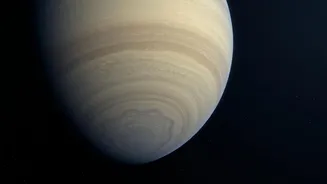
From Earth, Saturn appears as a serene, yellowish jewel. But up close, its atmosphere is a chaotic realm of hydrogen and helium, laced with traces of ammonia, methane, and other hydrocarbons that create its banded appearance. Winds whip through its upper
cloud layers at speeds of over 1,600 kilometres per hour, and massive storms, some larger than our own planet, can brew in its depths. Like Earth, Saturn is tilted on its axis, which means it experiences seasons. However, with an orbit that takes 29 Earth years to complete, each season on Saturn lasts for more than seven of our years, making long-term observation crucial to understanding its climate.
Hubble's Annual Check-Up
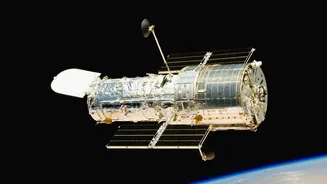
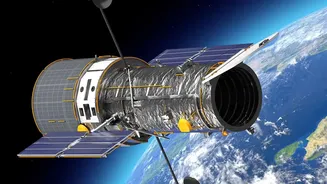
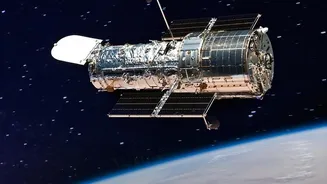
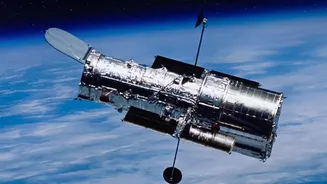
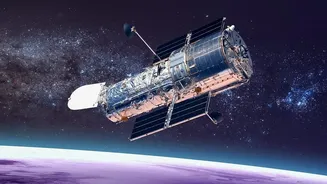
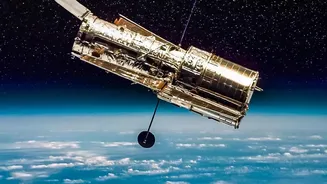
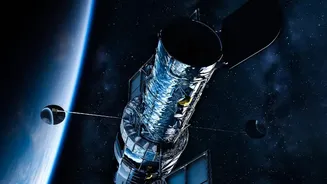
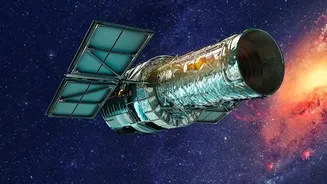
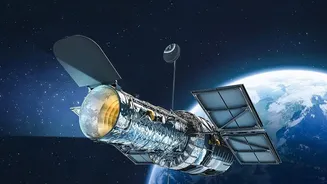
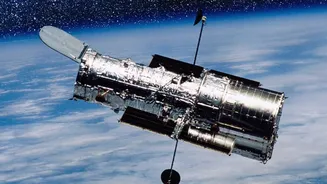
This is where the Hubble Space Telescope provides an invaluable service. Through a long-term initiative called the Outer Planet Atmospheres Legacy (OPAL) program, Hubble dedicates time each year to capture detailed images of our solar system's gas giants. This regular cadence allows scientists to build a continuous record of atmospheric changes, effectively creating a planetary weather report year after year. While spacecraft like Cassini provided breathtakingly detailed, close-up data during its 13-year mission, Hubble offers the persistence and longevity needed to track the slow, grand cycles of Saturn's seasons. The OPAL program ensures that even without a dedicated probe orbiting the planet, we are still gathering crucial data.
Tracking Storms and Shifting Bands
Hubble's sharp vision has revealed fascinating year-to-year changes. As Saturn's northern hemisphere moved through summer into autumn from 2018 to 2020, scientists observed its equatorial region brighten by as much as 10 percent. During that same period, equatorial wind speeds appeared to fluctuate, potentially indicating changes in cloud height. Scientists also noted subtle colour changes in the planet’s signature bands and a reddish haze developing over the northern hemisphere, possibly due to increased heating from summer sunlight. These observations capture the subtle progression of the seasons, showing how sunlight alters atmospheric circulation and chemistry on a global scale.
The Mystery of the Polar Polygons
Perhaps the most dramatic features Hubble has helped monitor are the bizarre geometric shapes at Saturn's poles. The north pole is famed for its long-lived, stable hexagon, a massive six-sided jet stream first seen by the Voyager spacecraft. More recently, as Saturn's seasonal tilt brought its south pole into better view, Hubble observations helped confirm the emergence of a new, 10-sided feature—a decagon. Piecing together images from 2023 onward, scientists have watched this decagon form, a discovery that surprised researchers who had seen no hint of it during the Cassini mission. Tracking how this new structure evolves will provide a natural laboratory for understanding the powerful fluid dynamics that shape the atmospheres of giant planets.
A Legacy of Discovery
Hubble's role extends beyond just the atmosphere. It has also helped unravel the mystery of 'ring spokes'—transient, ghostly features in the rings that appear and disappear seasonally. The OPAL program confirmed these are tied to Saturn’s seasons, likely caused by the interaction of the planet's magnetic field with solar radiation. By combining its visible and ultraviolet light observations with data from other missions, like the James Webb Space Telescope's infrared views, scientists can 'peel back' the layers of Saturn's atmosphere at different altitudes. Each yearly portrait from Hubble adds another crucial piece to the puzzle, helping us understand not just Saturn, but the fundamental workings of gas giants throughout our galaxy.