




The Coolest Experiment in Space
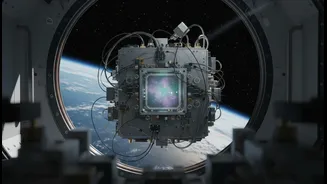
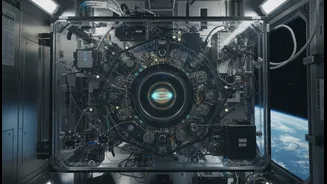
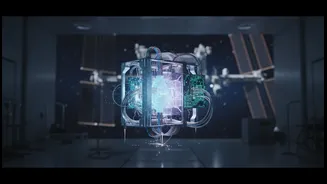
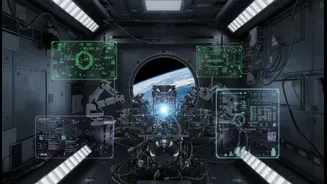
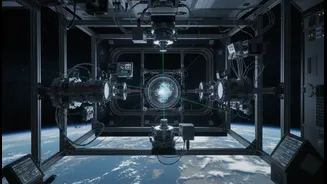
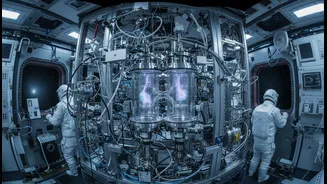
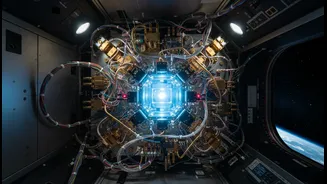
Aboard the International Space Station (ISS), a mini-fridge-sized experiment called the Cold Atom Lab is making history. Remotely operated by scientists on Earth, this facility cools atoms down to temperatures colder than deep space—just a fraction of
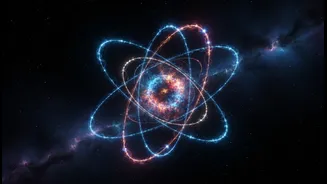
a degree above absolute zero. At these extreme temperatures, something incredible happens: the atoms stop behaving like individual particles and merge into a single quantum object known as a Bose-Einstein condensate (BEC). First predicted by Satyendra Nath Bose and Albert Einstein in the 1920s, this 'fifth state of matter' behaves like a single, massive matter wave. The microgravity of space is crucial, as it allows these condensates to be observed for much longer than is possible on Earth, where gravity quickly pulls them apart.
From Quantum Weirdness to Practical Tools
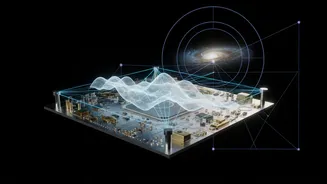
The purpose of creating these ultracold atoms isn't just to observe strange quantum phenomena. It's about harnessing them. The Cold Atom Lab is a testbed for a new generation of quantum sensors. These sensors use a technique called atom interferometry. Think of it like dropping two pebbles into a pond and watching how their ripples interact. In atom interferometry, scientists split a matter wave (the BEC) into two, let them travel along different paths, and then recombine them. Any force acting on the atoms, such as acceleration or gravity, will cause a tiny change in the interference pattern when the waves merge. Because these atoms are incredibly sensitive, the sensors can measure motion and gravitational fields with unprecedented precision.
A World Beyond GPS
Our current navigation systems, like GPS, rely on signals from satellites. While effective, these signals can be blocked by tall buildings, jammed, or simply unavailable, such as underwater or deep in underground tunnels. This is where quantum inertial sensors come in. By precisely measuring acceleration and rotation, these sensors can calculate a vehicle's position, velocity, and orientation without any external signal. While conventional inertial sensors exist, they suffer from drift and accumulate errors over time. Quantum sensors based on cold atoms are far more stable and accurate, potentially offering navigation that remains precise for hours or even days in GPS-denied environments. This could revolutionise everything from military operations and deep-sea exploration to the safety of autonomous vehicles in complex urban landscapes.
The Future of Finding Your Way
The research being conducted on the Cold Atom Lab, which received a significant upgrade in 2026, is fundamental. It is paving the way for instruments that could one day map water reserves under deserts, explore the hidden geology of other planets, or even search for mysterious dark matter. For those of us on Earth, the most immediate promise is a new layer of resilience and accuracy in how we navigate our world. Airbus is already exploring how quantum sensors that measure the Earth's magnetic field can provide an unjammable backup to GPS for aviation. While we may not have quantum compasses in our smartphones tomorrow, the work being done in orbit is a critical step. By pushing the boundaries of what's possible with quantum technology, scientists are laying the groundwork for a future where we are never truly lost.