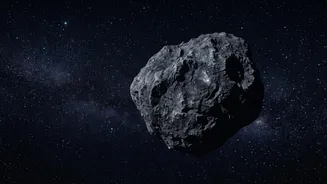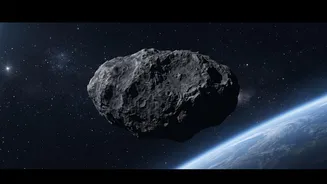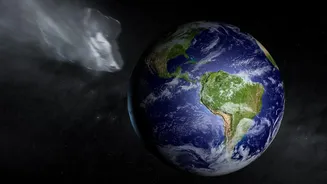


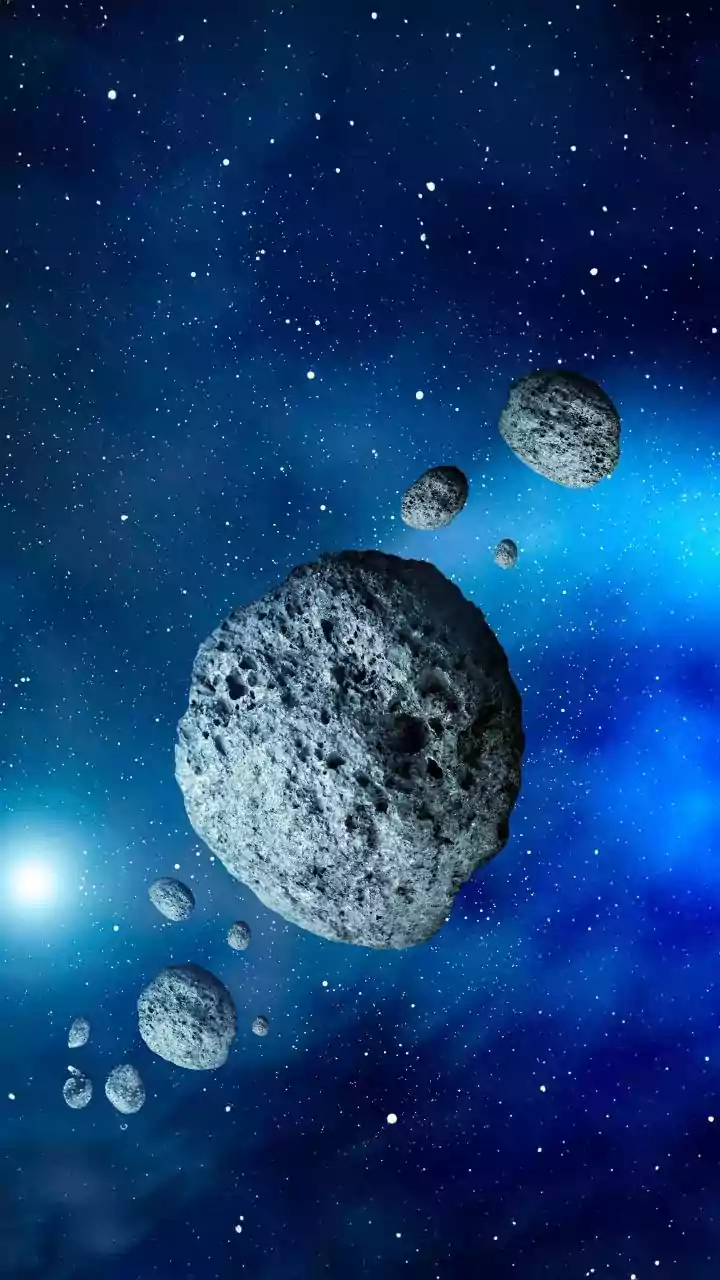


A tiny cosmic visitor that has been our planet’s temporary companion is now preparing to say goodbye. The asteroid, designated 2026 QQ8, has spent months in a looping orbit around Earth and is now drifting away.
Our Temporary Second Moon
Since April 2026, a small asteroid has been
circling our planet, acting as a temporary 'mini-moon'. This object, named 2026 QQ8, was captured by Earth's gravity but is now approaching the end of its visit. Discovered in August by Hungarian astronomer Krisztián Sárneczky, the object initially puzzled scientists, who debated whether it was natural or a piece of old space junk. After careful observation, it was confirmed to be a natural asteroid, just one to two metres in diameter. Its brief capture is a fascinating, yet not entirely uncommon, celestial event. Its orbit was never stable, instead following a chaotic, wobbly path influenced by the gravitational pull of both the Earth and our permanent Moon. Now, as November comes to a close, 2026 QQ8 is set to drift out of Earth's gravitational hold and continue its independent journey around the Sun.
Close, But Never a Danger
The phrase 'close-passing asteroid' can sound alarming, but 2026 QQ8 was never a threat. At its closest, it was about 1.5 times farther away than our own Moon. Its tiny size means that even if it had been on a collision course, it would have simply burned up in our atmosphere, likely creating a bright but harmless fireball. The real significance of 2026 QQ8 is not in any risk it posed, but in the opportunity it provided. Such flybys are a perfect test for our planetary defence systems. Tracking small, fast-moving objects helps astronomers refine their methods and ensures they are prepared to detect a genuinely hazardous object. Every 'mini-moon' is a fire drill for the systems designed to protect our planet.
The Global Hunt for Near-Earth Objects
Astronomers around the world are constantly scanning the skies for Near-Earth Objects (NEOs), a category that includes asteroids and comets whose orbits bring them into Earth's neighbourhood. Organisations like NASA's Planetary Defense Coordination Office (PDCO) work to catalogue and track these objects, calculating their paths to assess any potential impact risk. Using a network of ground-based and space telescopes, scientists compare images of the sky taken minutes apart to spot faint points of light that move against the background of fixed stars. Once a new NEO is found, its data is shared with the Minor Planet Center, a global hub that collects observations to calculate precise orbits. This international collaboration ensures that many eyes are watching the skies, working together to build a comprehensive map of our cosmic neighbours.
A Window into Our Solar System's Past
Beyond planetary defence, studying asteroids like 2026 QQ8 offers invaluable scientific insights. These space rocks are essentially leftovers from the formation of our solar system more than 4.5 billion years ago. By analysing their composition—even from a distance using techniques like spectroscopy—scientists can learn about the primordial materials that built planets, including our own. Some asteroids are rocky, while others are rich in carbon or even water ice, holding clues about how the building blocks of life may have been delivered to the early Earth. Each flyby allows for detailed observation, helping to piece together the history of our solar system, one rock at a time.
India's Growing Role in Watching the Skies
India is increasingly contributing to the global effort of asteroid tracking and planetary science. In the past, students from institutions like IIT Bombay have been instrumental in discovering asteroids making record-close passes of Earth, such as 2020 QG. Furthermore, the Indian Space Research Organisation (ISRO) has expressed ambitions to expand its role in studying NEOs, with a particular interest in the asteroid Apophis, which will make a historically close approach in 2029. These efforts, from grassroots student projects to national space agency goals, highlight India's growing presence in the vital work of understanding and monitoring our place in the cosmos.