


The 'Goldilocks Zone' Illusion
The concept of the habitable zone has been a powerful, simple tool for astronomers. It defines the orbital distance from a star where a planet's surface temperature could theoretically allow for liquid water, a non-negotiable ingredient for life as we know
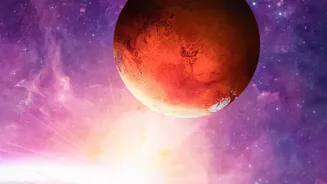
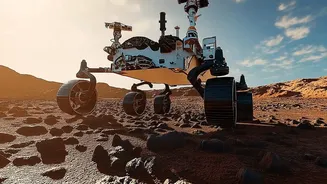
it. If a planet is too close to its star, its oceans boil away. Too far, and they freeze solid. This 'just right' distance, often called the Goldilocks Zone, has been the primary filter used to sift through the thousands of exoplanets discovered, narrowing the targets for further study. However, this single measure is proving to be a dramatic oversimplification. Planets within our own solar system, like Mars, sit within this zone but are not currently habitable on their surfaces. It turns out that a planet's orbit is just the opening chapter in the story of its potential for life.
A Star's Temperament Matters
A planet's habitability is deeply tied to the nature of its parent star. Many potentially habitable planets orbit red dwarf stars, which are smaller, cooler, and far more common than our sun. While their habitable zones are much closer to the star, this proximity comes with significant risks. Young red dwarfs are notoriously volatile, prone to releasing powerful stellar flares and coronal mass ejections that can strip a nearby planet of its atmosphere over time. This constant bombardment of high-energy radiation would be devastating to any burgeoning life on the surface. Furthermore, the intense gravity at such close distances can cause 'tidal locking,' where the planet always shows the same face to its star, resulting in one side being permanently scorched and the other frozen in darkness. A stable, predictable star like our sun is proving to be a rare and valuable asset.
The Importance of a Planetary Shield
Even with a stable star and a perfect orbit, a planet is defenseless without its own protection. A robust magnetic field, generated by a molten, rotating core, is critical. This magnetosphere acts as a planetary shield, deflecting the most harmful charged particles from the stellar wind that would otherwise erode the atmosphere. Mars, for example, is thought to have lost most of its once-thicker atmosphere after its internal dynamo shut down and its magnetic field dissipated. Without this shield, even a planet in the Goldilocks zone becomes a barren, irradiated rock. Mass is also a key factor; a planet needs to be large enough to retain its atmosphere through gravity, but not so large that it becomes a gas giant. Recent simulations suggest that for a planet to hold onto its atmosphere long enough for life to evolve, it needs to be at least the size of Mars.
An Atmosphere of the Right Kind
Finally, even if a planet has an atmosphere, the composition of that atmosphere is what truly makes or breaks its habitability. The recent detection of an atmosphere on a rocky world in the habitable zone, LHS 1140 b, was a landmark moment, but it's just the beginning. The next challenge is determining what the atmosphere is made of. A runaway greenhouse effect, like the one that turned Venus into a scorching hellscape, shows how the wrong mix of gases can be catastrophic. Using instruments like the James Webb Space Telescope, scientists are now able to analyze the starlight filtering through exoplanet atmospheres to look for 'biosignatures'—chemical fingerprints like oxygen, methane, and water vapor that could indicate biological processes. This complex work moves us beyond simply finding a planet at the right address and into the intricate business of vetting its entire environment.