

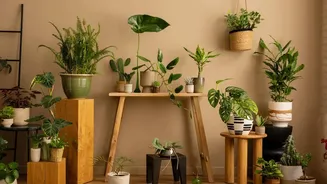
The Legend of the NASA Clean Air Study
The story begins in 1989 with a landmark study from NASA. In a search for ways to purify air on space stations, researchers placed common houseplants in small, sealed chambers and injected pollutants like formaldehyde and benzene. The results were remarkable:
plants like the spider plant, peace lily, and snake plant effectively removed a significant percentage of these volatile organic compounds (VOCs) from the air. The study concluded that for humans to exist in closed environments, they must take nature's life support system with them. This compelling finding was widely publicized and quickly became a cornerstone of the wellness and home décor industries. The idea was simple and appealing: a few well-placed plants could make your home a healthier place to breathe.
A Breath of Fresh Research
For thirty years, the NASA study remained the popular authority. However, recent analyses have put these findings into a real-world context, and the results are quite different. A pivotal 2019 review published in the Journal of Exposure Science and Environmental Epidemiology re-examined decades of research and came to a sobering conclusion. The original NASA experiments were conducted in small, sealed acrylic chambers—a scenario that has little in common with a typical home or office. Our living spaces are not airtight; they have constant air exchange from open windows, doors, and ventilation systems. This natural airflow dilutes pollutants much faster and more effectively than a handful of plants ever could.
Why Your Spider Plant Isn't a HEPA Filter
When you crunch the numbers, the myth begins to unravel. The 2019 review calculated just how many plants it would take to meaningfully impact a room's air quality. The findings were staggering: you would need anywhere from 10 to 1,000 plants per square metre of floor space to compete with a building's standard air exchange rate. To put that in perspective, purifying the air in a small 14-square-metre room would require around 680 plants. The rate at which plants absorb VOCs is incredibly slow compared to the rate at which fresh air enters your home. Simply opening a window for a few minutes provides a level of air purification that a veritable indoor jungle couldn't achieve. While plants do technically absorb some pollutants, the effect in a normal, ventilated room is considered negligible by many scientists today.
Don't Ditch Your Fiddle-Leaf Fig Yet
So, does this mean your houseplants are useless? Absolutely not. It just means we’ve been praising them for the wrong reason. The real, science-backed benefits of indoor plants are psychological, not atmospheric. Multiple studies have shown that being around plants can reduce stress levels, improve your mood, and even increase focus and productivity. They make spaces feel more comfortable and soothing. A connection to nature, even just a potted plant on your desk, has a measurable positive effect on our mental well-being. They add beauty, life, and a sense of calm to our homes. These benefits are powerful and valid, regardless of their ability to filter the air.
What Actually Cleans Your Indoor Air
If you are genuinely concerned about indoor air quality, there are far more effective strategies than buying another pothos. The number one recommendation from experts is ventilation. Open your windows regularly to allow fresh air to circulate and dilute indoor pollutants. Second, control the source of pollutants by choosing low-VOC paints and furnishings, and using exhaust fans when cooking. For those seeking a technological solution, a high-efficiency particulate air (HEPA) filter is designed specifically to capture airborne particles and will clean your air thousands of times more effectively than a plant. Combining good ventilation with source control is the most reliable way to maintain a healthy indoor environment.