





The Unseen Sentinels
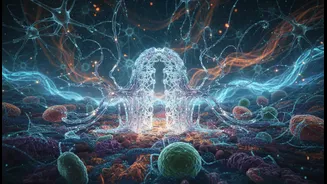
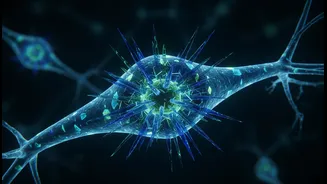
Imagine the intricate network of a bustling city. For decades, scientists believed they understood the basic infrastructure of our neurons, the brain's primary cells. They knew about a supportive structure just beneath the cell's surface called the membrane-associated
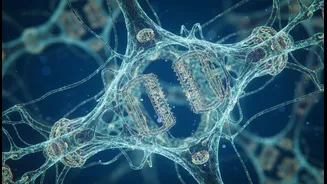
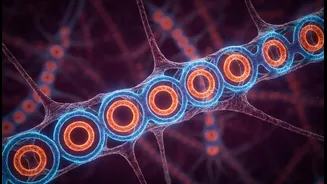
periodic skeleton, or MPS. For years, it was thought to be little more than passive scaffolding, the cellular equivalent of steel beams that simply help a neuron maintain its shape. This lattice-like framework was seen as a static, structural component, important but not particularly active. This long-held belief, however, was recently turned on its head by a team of researchers at Penn State, who decided to take a closer look at this humble skeleton.
A Surprising New Role
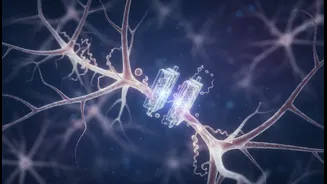
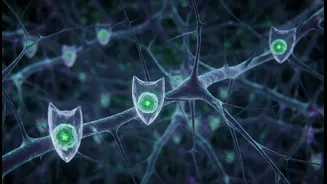
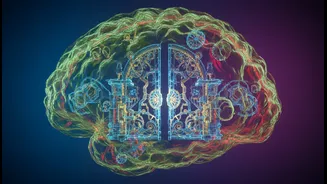
Using advanced super-resolution microscopy, which can see things 10,000 times smaller than a human hair, the Penn State team revealed the MPS's true identity. It is not a passive scaffold but an active and vital gatekeeper. The lead researcher, Ruobo Zhou, explained that this structure actively regulates a crucial process called endocytosis — the method by which neurons absorb nutrients, signaling molecules, and other materials from their surroundings. Think of it as the cell’s mouth. The MPS acts as a checkpoint, controlling when and where this intake happens. Instead of being a rigid wall, it’s more like a bouncer at an exclusive club, deciding what gets in and what stays out. This discovery fundamentally changes our blueprint of the neuron.
Why Scientists Are Fascinated
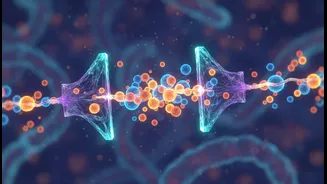
The reason this fascinates neuroscientists is that it adds a completely new layer of regulation to our understanding of brain function. We now know that the cell's very structure is an active participant in its daily operations. The discovery goes even deeper: the research showed that the MPS can dismantle parts of itself to create openings, allowing for more material to be absorbed when the neuron needs it. This creates a feedback loop; greater intake can lead to more structural breakdown and even higher levels of absorption. This dynamic, self-altering system was completely unexpected and opens up a thousand new questions about how learning, memory, and basic neural maintenance are controlled at this microscopic level. It’s a fundamental shift from a static to a dynamic view of the neuron’s inner workings.
New Hope for Old Diseases?
The most significant implication of this discovery lies in its connection to neurodegenerative diseases like Alzheimer's. A hallmark of Alzheimer's is the buildup of toxic protein aggregates, such as amyloid, in the brain. The Penn State study found that when the MPS is disrupted or weakened, it can no longer properly guard the gate. This leads to an uncontrolled, rapid intake of materials from outside the cell, including the very proteins that become toxic when they accumulate. In essence, a faulty gatekeeper lets the wrong crowd in, leading to the cellular damage seen in these devastating diseases. This finding is electrifying because it identifies a new potential target for therapies. If scientists can figure out how to protect and stabilize this gatekeeper structure, it could offer a novel way to prevent the toxic buildup and slow, or even stop, disease progression.
The Indian Context and The Road Ahead
For a country like India, with a growing elderly population, the burden of neurodegenerative diseases is a major public health challenge. Finding new ways to understand and combat conditions like Alzheimer's and Parkinson's is more urgent than ever. This fundamental research, while still in its early stages, provides a new direction for researchers worldwide, including those in India, to explore. The next steps will involve figuring out what causes the MPS to weaken with age or disease and developing strategies to strengthen it. The discovery of these microscopic gatekeepers hasn't provided a cure, but it has illuminated a new path in the dense and complex forest of brain research, giving scientists a fresh trail to follow in the quest for brain health.