




The Challenge of Cosmic Billiards
Popular culture often shows asteroids as chaotic rocks flying randomly through space, but the reality is more predictable and complex. Asteroids follow knowable orbital paths around the Sun, governed by the laws of physics. However, these paths are not
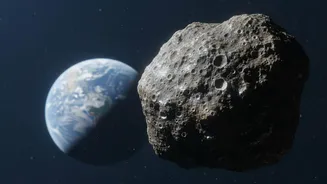
simple ellipses. They are constantly nudged and pulled by the gravitational forces of every planet and even the Sun itself. This creates a complex game of cosmic billiards where an asteroid's trajectory can change over time. Even tiny uncertainties in an asteroid's initial observed position can lead to huge variations in where it might be decades from now, making long-term prediction a significant challenge. This is why simply spotting an asteroid is not enough; its path must be mapped with incredible precision.
Finding the Needles in the Haystack
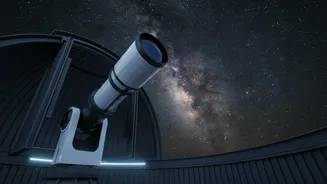
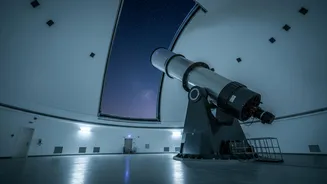
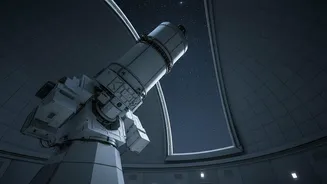
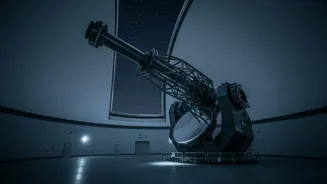
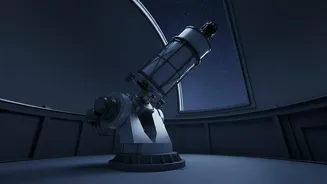
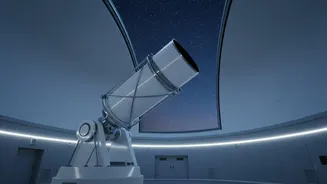
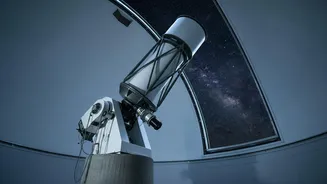
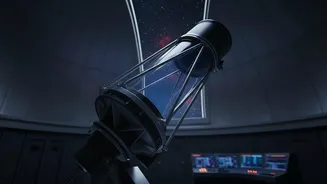
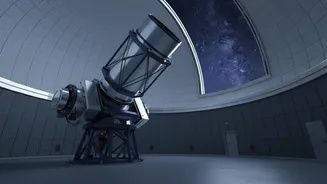
The first step in mapping an asteroid's path is simply finding it. Planetary defense starts with wide-field survey telescopes that repeatedly scan large portions of the night sky. Projects like the Catalina Sky Survey and Pan-STARRS compare multiple images of the same region taken minutes apart. Stars and galaxies remain fixed, but a moving Near-Earth Object (NEO) will appear as a tiny dot that has shifted its position. An automated system flags these moving objects, checking them against a database of known bodies. If it's a new discovery, it gets added to a confirmation list for other astronomers to observe. With thousands of new asteroids being discovered annually, this initial detection phase is a massive data-sifting operation. The upcoming Vera C. Rubin Observatory is expected to revolutionize this process, finding tens of thousands of new NEOs and dramatically increasing our catalog of the solar system.
From a Faint Dot to a Precise Orbit
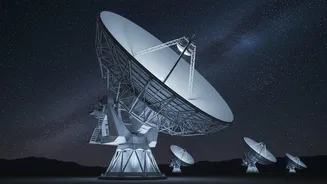
Once an object is detected, the real work of mapping its trajectory begins. A few initial observations create what scientists call a 'cone of uncertainty,' a wide range of possible paths the asteroid could take. To narrow this down, observatories around the world, including amateur astronomers, perform follow-up observations. Each new measurement of the asteroid's position against the background stars helps refine its orbit. For objects that come particularly close, scientists can use planetary radar systems, like the one at the Goldstone Observatory. Unlike optical telescopes that just see a point of light, radar can bounce radio waves off the asteroid to determine its size, shape, rotation, and distance with incredible accuracy, shrinking the cone of uncertainty even further.
The Software That Predicts the Future
All this observational data feeds into sophisticated computer systems managed by centers like NASA's Center for Near-Earth Object Studies (CNEOS). These systems use powerful algorithms to calculate the single orbital path that best fits all the available data. For years, a system called Sentry monitored the risk, but it has now been upgraded to Sentry-II. This next-generation algorithm is even more powerful, capable of modeling thousands of potential orbital variations to find even very low-probability impact scenarios that might have been missed before. Sentry-II can also account for subtle, non-gravitational forces that affect an asteroid's path over long periods, like the Yarkovsky effect—a tiny push caused by the way the asteroid absorbs and re-radiates heat from the Sun. By running these complex calculations, scientists can project an asteroid's path forward for the next 100 years and beyond, assessing any potential impact risk with increasing confidence.
The Future of Planetary Defense
The technology for deep sky defense is constantly evolving. The Vera C. Rubin Observatory in Chile will soon begin a decade-long survey, creating the largest time-lapse movie of the southern sky and is expected to find as many asteroids in its first year as have been documented in the past 200 years. Furthermore, space-based telescopes like NASA’s planned NEO Surveyor will be positioned to spot asteroids that are difficult to see from Earth, such as those that approach from the direction of the Sun. These new tools, combined with ever-improving software like Sentry-II, represent a multi-layered and increasingly robust system for mapping the solar system. It is a global effort that combines discovery, tracking, and complex computation to provide us with the ultimate early-warning system.