


The First Glimmer of Discovery
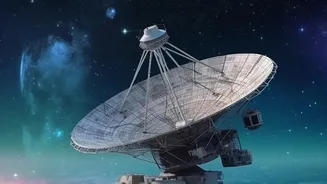
The hunt for a new moon often begins with a faint, unassuming speck of light in a telescope image. Astronomers use powerful observatories on the ground and in space to take long-exposure pictures of distant planets. By comparing images taken over hours,
days, or even years, they look for any 'star' that moves with the planet instead of remaining fixed in the background. This initial detection is a painstaking process of elimination. Since the invention of the telescope, this fundamental method has been the starting point for moon discoveries, from Galileo's first glimpse of Jupiter's four largest moons in 1610 to modern campaigns. Today, however, the challenge is finding objects that can be 100 million times fainter than what the naked eye can see.
Peering Through a Dusty Veil
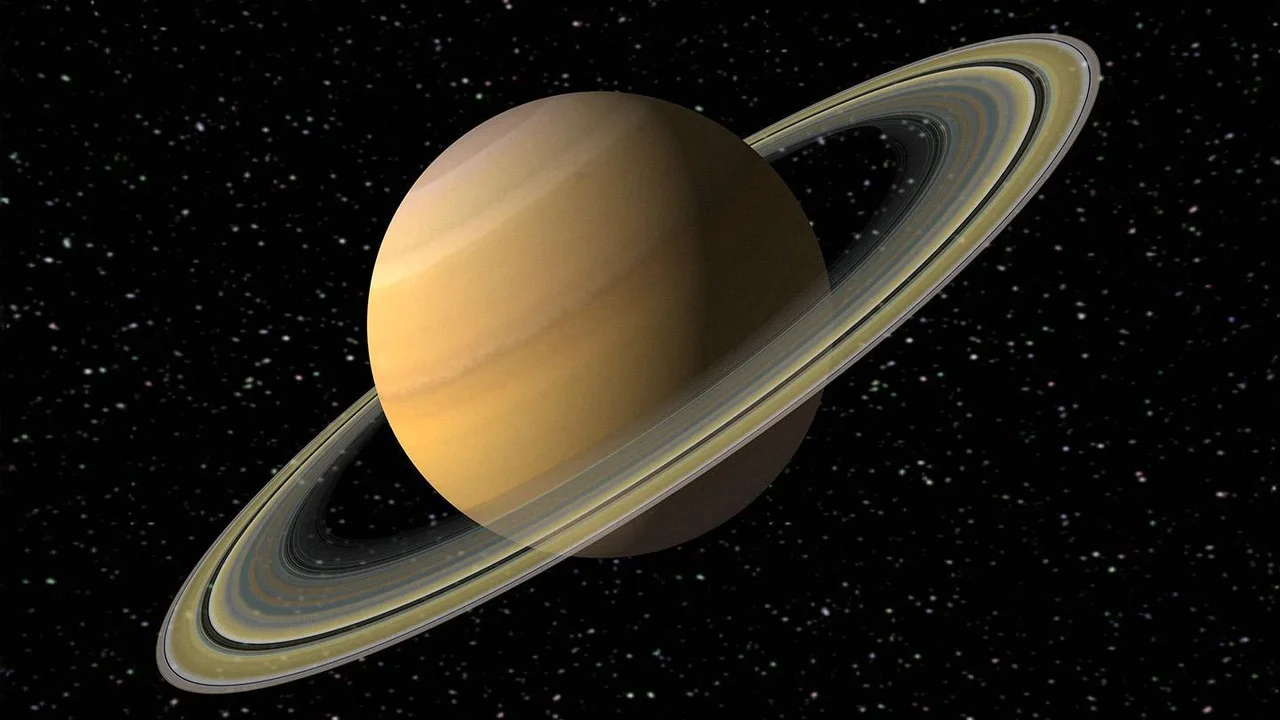
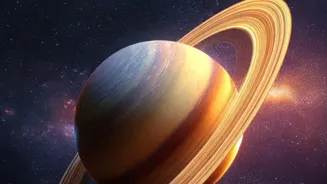
A planet's rings present a unique and formidable challenge. Composed of countless particles of ice and rock, these rings can easily hide a small moon or be mistaken for one. A clump of ring material might temporarily appear as a single bright object, fooling observers. To overcome this, scientists employ a 'shift-and-stack' technique. They take multiple images and align them based on the predicted orbital speed of a potential moon. If a moon is present, it will become brighter and clearer in the stacked image, while the background stars and random ring debris will blur out. This method helps separate the consistent signal of an orbiting body from the visual noise of the rings themselves. The rings of planets like Jupiter and Uranus are much thinner and made of darker, dust-like particles, which can make detection slightly different than for Saturn's bright, icy rings.
The Confirmation: It’s All About the Orbit
Spotting a moving dot is just the beginning. To be confirmed as a moon, the object must be proven to be gravitationally bound to the planet. This requires tracking it for a significant period to plot its orbit. Scientists need to observe the potential moon long enough to demonstrate that it follows a stable, repeating path around the planet. Once they have enough positional measurements, they submit them to the International Astronomical Union's Minor Planet Center, the official body responsible for cataloging such discoveries. This organization analyzes the data to verify the orbit. If the path is confirmed, the object is given a provisional designation, like S/2023 S 51, before it eventually receives a permanent name.
The Unseen Pull: Detecting Gravity’s Signature
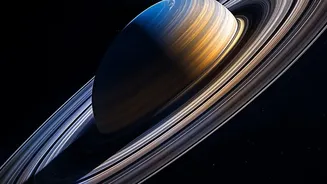
Sometimes, the most convincing evidence is invisible. A moon, no matter how small, exerts its own gravitational pull. This can cause a tiny 'wobble' in the planet's own motion or disturb the orbits of other nearby moons. By precisely measuring these perturbations, scientists can confirm a moon's presence and even calculate its mass without ever seeing it directly. This radial velocity method is a key technique used in the search for planets around other stars (exoplanets) and is being adapted to find their moons (exomoons). In a ring system, a small moon's gravity can create gaps or waves in the ring material, acting as a clear signpost of its location. These gravitational resonances are responsible for many of the features we see in Saturn's famous rings.
A Case Study: Saturn’s Growing Family
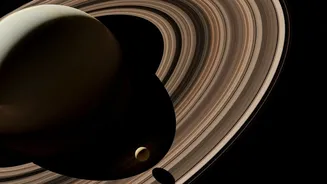
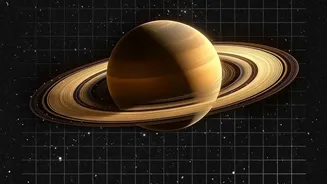
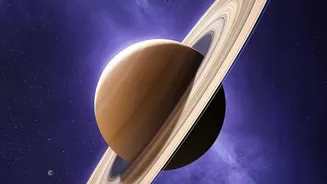
Saturn is a perfect example of this process in action. The ringed giant is now known to have the most moons in the solar system, with dozens discovered in recent years alone. Many of these are tiny, irregular bodies just a few kilometers across, likely fragments of larger objects that collided long ago. Finding them required years of observations and sophisticated analysis. Discoveries announced in early 2026, for example, were based on observations made over several years prior. Each of these small worlds had to be meticulously tracked to prove it was a true satellite and not just a passing asteroid or a temporary clump in the rings, solidifying Saturn's title as the 'moon king' of our solar system.