







What is the Square Kilometre Array?
The Square Kilometre Array is the world's largest and most sensitive radio telescope. It isn't a single dish, but a massive network of thousands of antennas spread across two remote, radio-quiet locations in South Africa and Australia. These two arrays,
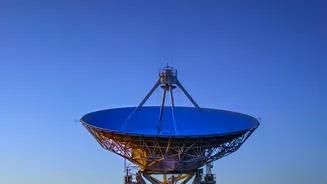
SKA-Mid in South Africa and SKA-Low in Australia, will work together as one giant, virtual observatory. SKA-Mid will use 197 traditional dish antennas, while SKA-Low will consist of over 131,000 smaller, tree-like antennas. This colossal project is the result of a global collaboration involving more than a dozen countries, with its headquarters in the United Kingdom. India is a full member, contributing significantly to the project's development.
A Giant Leap in Power and Scale
The SKA's sheer size gives it unparalleled sensitivity and survey speed. The goal is to create a combined collecting area of one square kilometre. This will make it 50 times more sensitive than any previous radio instrument and capable of mapping the sky thousands of times faster. This power allows astronomers to detect the incredibly faint radio signals emitted by celestial objects across cosmic history. The torrent of information produced will be staggering, requiring some of the world's fastest supercomputers to process an amount of data that will exceed the entire world's internet traffic from just a decade ago. By using a technique called interferometry, which combines the signals from widely spaced antennas, the SKA will achieve image resolution far exceeding even the Hubble Space Telescope.
Tackling the Universe's Biggest Questions
The SKA has a broad and ambitious set of scientific goals designed to push the boundaries of our knowledge. One of its primary missions is to look back in time to the 'Cosmic Dawn', the era just after the Big Bang when the very first stars and galaxies began to form. It will also put Albert Einstein's theories of gravity to the ultimate test by observing pulsars, rapidly rotating dead stars, to look for gravitational waves. Furthermore, the SKA will investigate the mysteries of dark matter and dark energy, the enigmatic forces that shape the evolution of the universe. Scientists will also use its powerful capabilities to search for complex molecules, the building blocks of life, in space, bringing us closer to answering whether we are alone in the universe.
India's Pivotal Role in the Project
India has been a key player in the SKA project since its early days and is now a full member of the SKA Observatory. The nation has committed ₹1,250 crore to the project's construction phase. A consortium of over 20 Indian institutions, led by the National Centre for Radio Astrophysics (NCRA) in Pune, is steering the country's involvement. India's most significant contribution has been the development of the Telescope Manager, the complex software 'neural network' that will control the entire telescope's operations. This places Indian scientific and technical expertise at the very core of the SKA, building on the country's rich legacy in radio astronomy, exemplified by the Giant Metrewave Radio Telescope (GMRT) near Pune.
The Dawn of a New Astronomical Era
Construction of the SKA officially began in late 2022 in both Australia and South Africa, with the project being built in phases. The first major science observations are expected to begin towards the end of the decade, with the telescopes planned to be fully operational around 2029. As the arrays are progressively built out and brought online, their capabilities will surpass existing telescopes, offering early glimpses of their future potential. This phased approach ensures a steady stream of scientific discovery even during the construction period. The SKA is not just an upgrade; it's a transformational leap that promises to rewrite textbooks and change our perspective on the cosmos. It marks the beginning of a new golden age of astronomy, powered by global collaboration and human curiosity.