







Beyond the 'Goldilocks' Myth
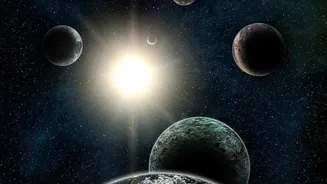
The concept of the habitable zone, often called the “Goldilocks zone,” is simple and appealing. It describes the orbital region around a star where temperatures could theoretically allow liquid water to exist on a planet's surface. For a long time, finding
a planet in this zone was seen as the jackpot in the hunt for another Earth. However, this idea assumes a planet is a simple billiard ball waiting to be warmed. The reality is far more complex. A planet's own characteristics, particularly its mass and radius, are just as important as its location. Without the right size, a perfect orbital position means very little.
The Small Planet Problem
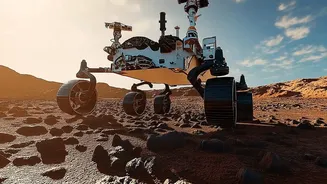
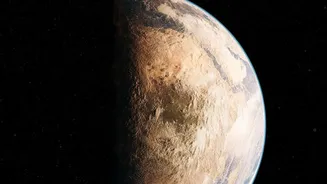
A planet that is too small, even one orbiting comfortably within the habitable zone, faces a bleak future. The main issue is gravity. A low-mass planet simply doesn't have enough gravitational pull to hold onto a substantial atmosphere over billions of years. Stellar winds and radiation from its parent star will gradually strip away the gases, leaving an airless, barren rock. Mars is a prime example in our own solar system; evidence suggests it once had a thicker atmosphere and liquid water, but its small size meant it couldn't prevent its atmosphere from leaking into space. Recent modeling suggests a rocky planet needs to be at least 80% of Earth's width to retain its atmosphere long-term. Anything smaller than about 2.7% of Earth's mass will lose its atmosphere so quickly that surface water never has a chance to form.
The Super-Earth Dilemma
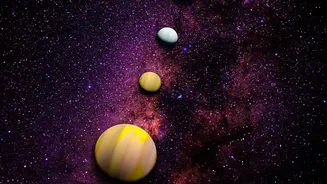
If small is bad, is bigger always better? Not necessarily. Planets significantly more massive than Earth, known as “super-Earths,” present their own set of challenges. Their powerful gravity is excellent at retaining an atmosphere, but it might be too effective. This can lead to incredibly thick, crushing atmospheres that trap too much heat, creating a runaway greenhouse effect far beyond what we see on Venus. These worlds might not have a solid surface at all, instead becoming “mini-Neptunes” with vast, deep atmospheres. Even if rocky, the immense gravity would make life as we know it difficult. While super-Earths are common, finding one that threads the needle between having enough atmosphere and having too much is a major challenge for astronomers.
The Engine Within
A planet's size also dictates its internal life. Earth is geologically active, with a molten core that generates a protective magnetic field and drives plate tectonics. This activity is vital for habitability. The magnetic field shields us from harmful cosmic radiation, and volcanic activity releases gases that replenish the atmosphere and help regulate the climate over geological timescales. A smaller planet cools down much faster. Its core solidifies, its magnetic field dies, and its volcanism ceases. Without this internal engine, the planet's atmosphere is vulnerable and its climate can no longer self-regulate. Conversely, recent studies suggest super-Earths may sustain volcanism and magnetic fields for far longer than Earth, potentially extending their window for habitability if other conditions are right.
A More Refined Search for Life
Understanding the importance of planetary size has fundamentally changed how scientists search for life. It's no longer enough to just find a world in the habitable zone. Modern telescopes like the James Webb Space Telescope, and future missions, are designed to analyze planetary atmospheres for clues about their composition and density. Scientists are now focusing on a narrower subset of candidates: rocky worlds that are not too big and not too small, orbiting at just the right distance. The recent detection of an atmosphere on the super-Earth LHS 1140 b, a rocky world in its star's habitable zone, is a landmark discovery because it confirms that a planet of the right size can indeed hold onto its atmosphere.