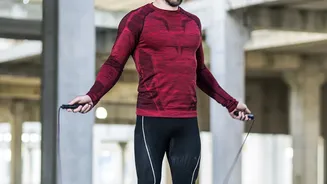







Cardio Intensity and Heart Health
The most significant difference between walking and skipping lies in cardiovascular intensity. Walking is generally a low- to moderate-intensity activity. It elevates your heart rate gently, making it a sustainable and safe choice for improving heart health,
especially for beginners. In contrast, skipping is a vigorous-intensity exercise. It causes your heart rate to spike quickly, challenging your cardiovascular system in a shorter amount of time. In fact, experts suggest that one minute of vigorous activity like skipping can be equivalent to two minutes of moderate activity like brisk walking. This makes skipping an excellent option for high-intensity interval training (HIIT), where you alternate short bursts of intense effort with rest periods.
The Calorie Burn Showdown
If your goal is maximum calorie burn in minimum time, skipping is the clear winner. Due to its high intensity and full-body engagement, skipping torches calories at a much faster rate than walking. A person can burn over twice as many calories from skipping compared to walking for the same duration. For example, a 30-minute session of brisk walking might burn around 150-200 calories, while 30 minutes of skipping could burn well over 400-500 calories. This incredible efficiency makes skipping a go-to for those with busy schedules who want to maximise their workout. However, it's worth noting that most people can walk for much longer than they can skip, so a long walk can still result in a significant total calorie burn.
A Question of Impact
The term 'high-impact' in the headline is key. Walking is a low-impact exercise because one foot is always on the ground, which is gentle on the joints. Skipping, on the other hand, is a high-impact activity because you leave the ground with both feet and land, creating a force on your bones and joints. This isn't necessarily a bad thing. This impact stimulates bone-building cells, which can help increase bone density and reduce the risk of osteoporosis later in life. However, the high impact can pose a risk for individuals with pre-existing joint issues, particularly in the knees and ankles. Proper technique, a good jumping surface, and supportive footwear are crucial to minimise injury risk.
Muscles, Coordination, and Skill
Walking is a fantastic lower-body exercise, primarily working your glutes, hamstrings, quadriceps, and calves. While it's a great functional movement, it doesn't challenge the upper body or core to the same degree. Skipping provides a true full-body workout. The legs are constantly working to jump and land, the core must stay engaged to maintain stability and posture, and the shoulders, forearms, and wrists are used to control the rope. Beyond muscle engagement, skipping is a skill-based movement that improves coordination, balance, rhythm, and agility—benefits that translate well to other sports and daily activities.
Accessibility, Cost, and Convenience
In terms of accessibility, walking is unbeatable. You can do it almost anywhere, at any time, and it requires no special equipment beyond a comfortable pair of shoes. It has no learning curve, making it the perfect entry point for fitness. Skipping is also highly accessible but comes with a few more barriers. You need a jump rope—though these are inexpensive—and enough clear space to swing it. There is also a learning curve; beginners often struggle with timing and coordination. It takes practice to be able to skip continuously for an extended period. Once mastered, however, its portability makes it a great workout you can do at home or while traveling.